

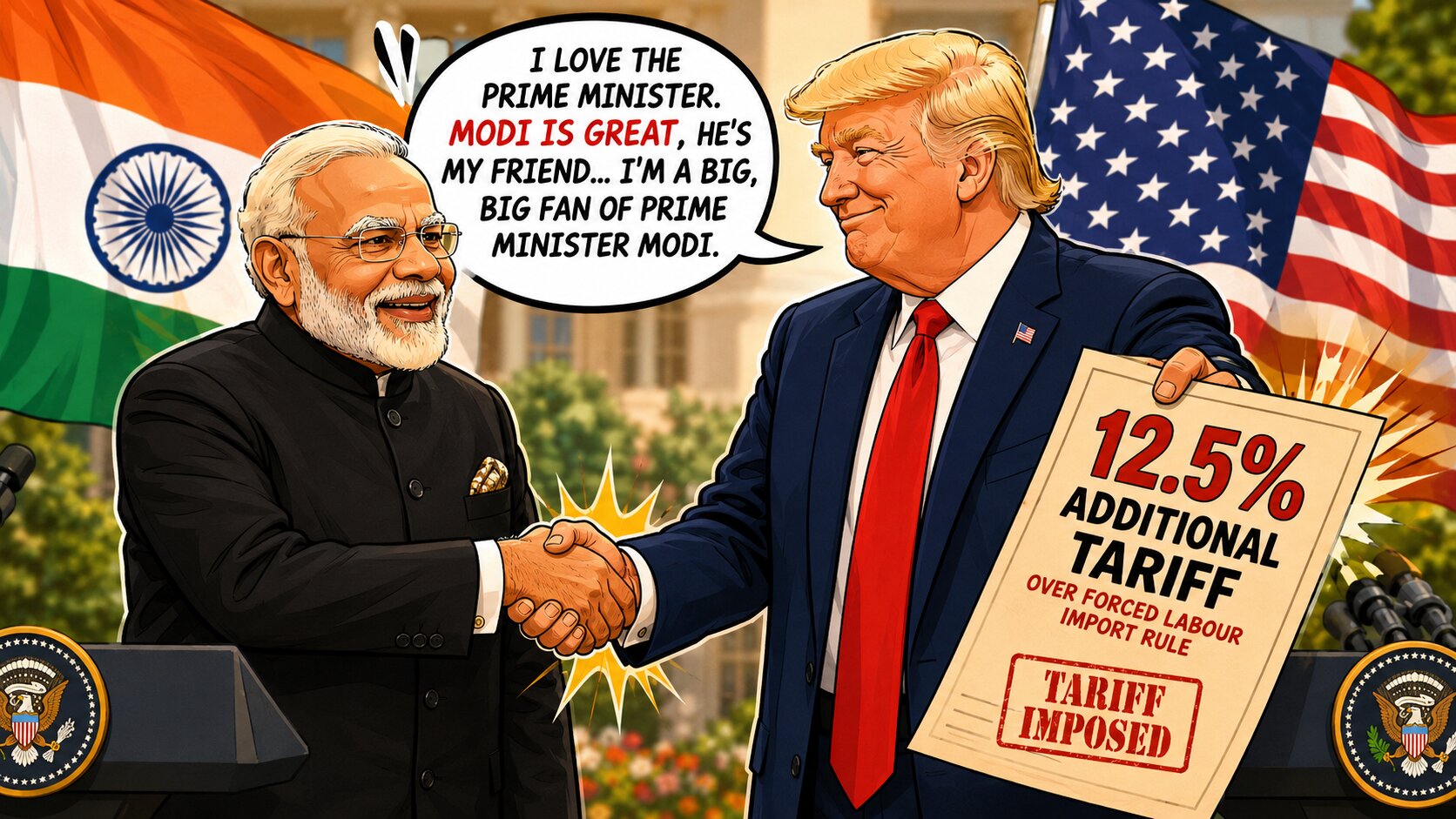
The Friendship Tax: How US’s Forced Labour Tariff Gambit Could Quietly Rewire India-US Trade
When America accuses a “great friend” of enabling modern slavery, the diplomacy gets complicated fast.
There’s a peculiar choreography playing out in New Delhi this week. On one floor of a government building, American trade negotiators led by Assistant USTR Brendan Lynch are sitting across from Indian officials, racing to finalize the last stretch of a landmark US-India Bilateral Trade Agreement (BTA), one that both sides have invested considerable political capital in. On another floor, the same Indian officials are quietly seething. Because at almost the exact moment those talks began, Washington dropped a document that called India a country that has “failed to impose and effectively enforce a forced labor import prohibition” and proposed slapping 12.5% tariffs on its exports.
This is the contradiction at the heart of the India-US trade relationship in 2026: one hand extends partnership; the other reaches for leverage.

The Accusation India Didn’t Expect
Let’s be precise about what Washington is actually saying, because the framing matters enormously. The Office of the United States Trade Representative (USTR) investigation is not based on allegations that Indian exports are produced using forced labour. Rather, the action focuses on whether countries prohibit imports made with forced labour in third countries.
In other words, India isn’t being accused of running sweatshops. It’s being accused of not having a law that stops others’ sweatshop goods from flowing through Indian ports and supply chains. It’s a subtle but critical distinction, one that Indian officials have largely failed to communicate to their own domestic audience, and one that Washington has conveniently blurred.
The Confederation of Indian Textile Industry has already called the forced labour allegations “completely false” and “unfair,” and they aren’t entirely wrong. India has constitutional prohibitions on forced labour. What it lacks is a customs enforcement mechanism that mirrors the US Uyghur Forced Labor Prevention Act, a law that places the burden of proof on the importer, not the state. Washington wants the world to replicate its enforcement architecture. That’s not a labour standard. That’s regulatory imperialism dressed in humanitarian language.
What’s Really at Stake for Indian Business
The sectors most exposed are the ones least equipped to absorb a sudden cost shock. Textiles, garments, gems and jewellery, home furnishings, labour-intensive industries where a 12.5% duty would directly raise the landed cost of Indian goods in the US market, eroding the price advantage Indian exporters have carefully built over decades.
Consider the irony in gems and jewellery: India’s gem and jewellery sector accounts for around 7% of GDP, with gross exports at $25.73 billion in FY25. Much of that craftsmanship is artisanal, family-run, centuries-old. Calling it “forced labour” even by association is not just economically damaging; it’s reputationally corrosive in a market where provenance and ethics increasingly drive consumer choices.
The hidden threat, though, isn’t the tariff itself, it’s the compliance architecture it will birth. Indian exporters who source cotton, chemicals, solar components or intermediate goods from China or other flagged nations could face greater customs checks and additional documentation requirements to prove their supply chains are free from forced-labour links, increasing operational costs even before a single tariff rupee is paid. Small exporters in Tiruppur and Ludhiana who don’t have compliance departments and legal teams will drown quietly in paperwork.
The BTA Gambit: Negotiating Under Fire
Here’s the uncomfortable truth: this tariff proposal may not be designed to punish India. It may be designed to pressure it.
India is caught in at least two separate Section 301 probes, the forced-labour inquiry that produced Tuesday’s proposal, and a separate capacity-related investigation against 16 countries, including China, Japan, and the EU, whose findings are expected shortly. That’s two economic swords dangling over New Delhi’s head simultaneously, both timed to the BTA’s final negotiating sprint.
India’s position is that signing a BTA should provide a shield against such unilateral tariff actions. Washington hasn’t confirmed that. And that asymmetry where India is negotiating partly to escape punitive measures rather than purely to unlock opportunity fundamentally shifts the psychology at the table. You don’t negotiate as equals when one party holds the tariff gun.
The exception list tells its own story. The proposed tariffs exempt beef, coffee, certain fruits, and goods from Canada and Mexico that comply with the North American free trade pact. Canada and Mexico, USMCA partners get protection. India, despite being America’s self-described “great friend” and a fellow democracy, gets a 12.5% penalty. Friendship, apparently, has a tiered pricing structure.
What Can India Actually Do?
Three realistic pathways exist, none of them clean.
First, India can fight on legal and procedural grounds. India should argue that the US is attempting to impose its preferred import-control framework on sovereign nations through unilateral trade measures, an action outside the intended scope of Section 301. The public comment period runs until July 6, hearings begin July 7, India should mount an aggressive, evidence-heavy submission. This is a legal battle, not just a diplomatic one.
Second, India can use the BTA as a bargaining chip. Indian negotiators may now focus on securing exemptions, relief measures, or a lower tariff classification as part of the BTA framework, rather than simply chasing market access gains. Tying tariff relief to deal closure gives both sides a face-saving exit.
Third, and this is the uncomfortable option India could accelerate domestic supply chain reform. Developing a traceable, certification-based system for key export sectors wouldn’t just answer Washington; it would also make Indian goods more attractive to the EU’s incoming due diligence frameworks and ESG-conscious global buyers. The compliance burden can either be a cost or a competitive moat, depending on how early you build it.
The Cost Washington Won’t Count
America’s domestic calculus here is myopic. The US imports heavily from India across pharmaceuticals, IT services, industrial machinery, and yes textiles and jewellery that consumers have embedded into their daily lives. A 12.5% tariff doesn’t disappear; it gets passed on. US retail prices rise. Inflation, already a political wound, gets salted.
More dangerously, every time Washington treats a “strategic partner” like a trade adversary, it nudges that partner toward hedging. India has options, the EU, Gulf markets, ASEAN. Not equivalent options yet, but growing ones. A US that weaponizes every trade tool it possesses may find that its most useful allies start building exits.
The forced labour argument is not cynical in its origins. Modern slavery in global supply chains is real and serious. But a blanket 12.5% tariff on 60 countries including the UK, EU, Japan, and India stretches the moral argument beyond credibility. When everyone is guilty, the charge loses meaning. What remains is a trade enforcement mechanism in humanitarian clothing.
Modi may be Trump’s “great friend.” But in US, Washington’s trade policy, friendship is a sentiment. Tariffs are a structure. And right now, the structure is winning