

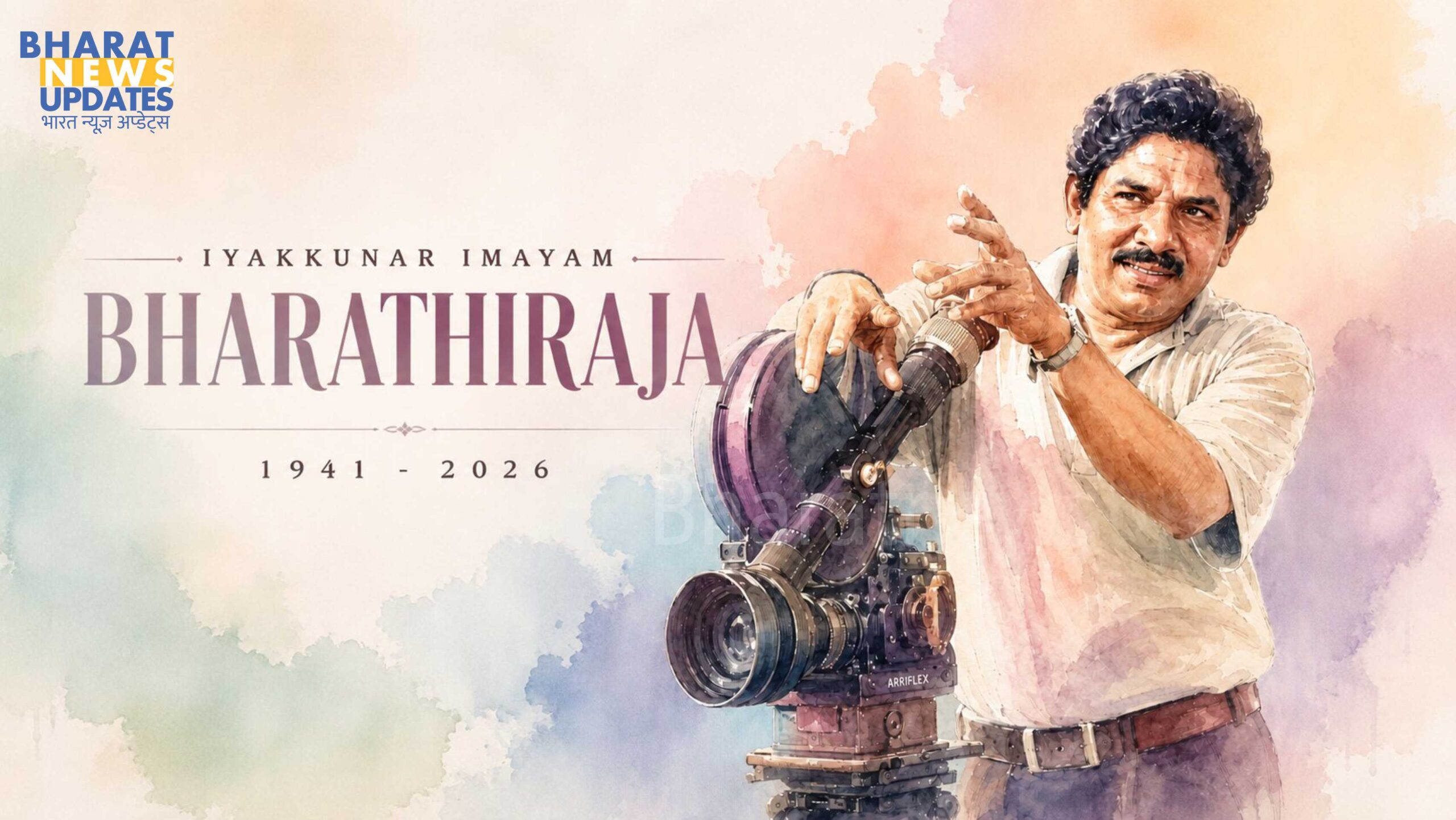
The Man Who Gave Tamil Cinema Its Soil Back: A Tribute to Bharathiraja (1941–2026)
He was born Chinnasamy. Tamil cinema knew him as Iyakkunar Imayam, the Peak of Directors. And now, on the very morning the world woke up to June 10, 2026, that peak went quiet.
Bharathiraja passed away at 84, leaving behind a grief that runs deeper than the loss of a filmmaker. He leaves behind the grief of a world: sun-baked fields, village wells, dusty crossroads that only he could put on screen without lying about it.
The Film No One Wanted to Fund
Here is something most obituaries will skim past: 16 Vayathinile almost did not exist.
The National Film Development Corporation initially agreed to fund it, then backed out. The film was originally titled Mayil named after its protagonist and was nearly stillborn before producer S.A. Rajkannu stepped in. Even after it was shot, it was screened at least 20 times for distributors, and Bharathiraja‘s preferred linear narrative kept getting switched to a non-linear flashback structure because no one trusted the film to work any other way. Eventually, Rajkannu released it himself, with the flashback intact.
Budget: ₹5 lakh. The film ran for 175 days.
That production, shot entirely outdoors in Mysore and Kollegal making it the first Tamil film to be filmed completely without sets contained within it a future Bollywood icon, two of Tamil cinema’s greatest stars, and the first raga of what would become the most consequential musical partnership in Tamil film history.
Ilaiyaraaja, incidentally, had initially refused to compose for it.
Sridevi: Before Bollywood, There Was Bharathiraja
When Sridevi leapt through those sunlit fields in Chendoora Poove, she was 14 going on 15. She did not run in slow motion because the song demanded it, she ran in slow motion because the crew could not afford a camera capable of actual slow-motion photography. So Sridevi ran slowly, deliberately, repeatedly, until it looked real.
That is the kind of director Bharathiraja was: he turned budget limitations into visual poetry.
The spitting scene between Sridevi and Rajinikanth where Mayil spits in defiance at the menacing Parattai required so many takes that Rajinikanth eventually insisted Sridevi actually spit on him for real. She did. The rawness you see on screen? It is not performance. It is mud-and-sweat real.
Bharathiraja later remade the same story in Hindi as Solva Sawan (1979), again with Sridevi, marking her debut as a leading actress in Hindi cinema. The Hindi remake failed. Some stories, it turns out, belong to their soil.
Sridevi went on to become Bollywood’s greatest female star. She passed away in 2018. But her most honest, unguarded performance, the one where she is not yet a star but simply a girl navigating desire and danger belongs entirely to Bharathiraja.
The Contradiction Nobody Talks About
Tamil cinema remembers Bharathiraja as the poet of rural landscapes. What it tends to forget is that he was equally at home in urban dread.
Sigappu Rojakkal (1978) is among the most disturbing Tamil films ever made. Kamal Haasan as a charming, misogynist serial killer not raging, not theatrical, but believably ordinary was a creative risk that the same man who made pastoral romances had no business pulling off. He pulled it off anyway.
The same tension between tenderness and darkness runs through Tik Tik Tik (1981), Oru Kaidhiyin Diary (1985), and even Bommalattam (2008). There were always two Bharathirajas: one who filmed the wind moving through paddy fields, and one who filmed what happens inside the mind when something goes wrong.
Most directors are one or the other. He was both.
The Eyes He Trusted, The Voices He Found
Bharathiraja had a particular genius for people. Cinematographer B. Kannan, later known as “Bharathirajavin Kangal” (Bharathiraja’s Eyes) became synonymous with his visual language. When Kannan passed away in 2020, a certain texture disappeared from Tamil cinema permanently.
Then there was music. With Ilaiyaraaja, Bharathiraja did not just make soundtracks, he made soundscapes that smelled like the districts they came from. But he never got trapped by that success. AR Rahman’s earliest, most earthbound work came through Kizhakku Cheemayile (1993), where Rahman still known for synth-heavy, westernised sounds was asked to compose something rooted in rural Tamil rhythms. That experiment helped shape what Rahman would later become.
Hamsalekha in Kodi Parakkuthu (1988). Devendran in Vedham Pudhithu (1987). Every collaboration was a declaration that Bharathiraja was never sentimental about his partnerships, only about his films.
What Caste, Crime, and Female Infanticide Looked Like in His Hands
Vedham Pudhithu (1987) remains one of the most unflinching examinations of caste ever produced in mainstream Tamil cinema. Sathyaraj’s Balu Thevar is an avowed atheist who rails against Brahminical hierarchy but whose own untested caste prejudices surface when his daughter falls in love across caste lines. The film does not let anyone off the hook, least of all the man it initially positions as progressive.
Karuthamma (1994) brought female infanticide, a practice then quietly devastatingly common in parts of rural Tamil Nadu into the mainstream conversation without disguising itself as art cinema. It was a commercial film. That was precisely the point. The people who needed to see it were not going to the film festival.
The Last Years: A Father’s Private Grief
What the industry rarely mentions is the weight Bharathiraja carried in his final years. His son Manoj- actor, director, the boy he had introduced in Taj Mahal (1999) died of a cardiac arrest on March 25, 2025, aged 48. Manoj had returned home after bypass surgery just before his heart gave out. He was survived by his wife Nandana and two daughters.
Bharathiraja was hospitalized in Chennai later that year with respiratory complications. The photographs that circulated, a frail man surrounded by medical equipment were painful for anyone who remembered him striding through sugarcane fields with a camera and a certainty that cinema could be better than it was.
He had, in those last months, buried his son and his health simultaneously. He kept both griefs private.
He died today, June 10, 2026.
What He Left Behind
He left behind a cinema where landscapes are not backdrops but characters. A cinema where waiting for a prisoner’s return, for love across caste lines, for a daughter who may never come home is treated as one of the most dramatic acts a human being can perform.
He left behind Sridevi running in slow motion through fields she made eternal. He left behind a generation of filmmakers who learned from him that a camera pointed at real sky tells a more honest story than any painted set ever could.
And he left behind one of cinema’s most underrated truths: that the most radical thing a filmmaker can do is refuse to make the world prettier than it is.
Rest, Iyakkunar Imayam. The fields remember you
Bharatnewsupdates Cinema Insight Team ⊥ June 2026, 10