

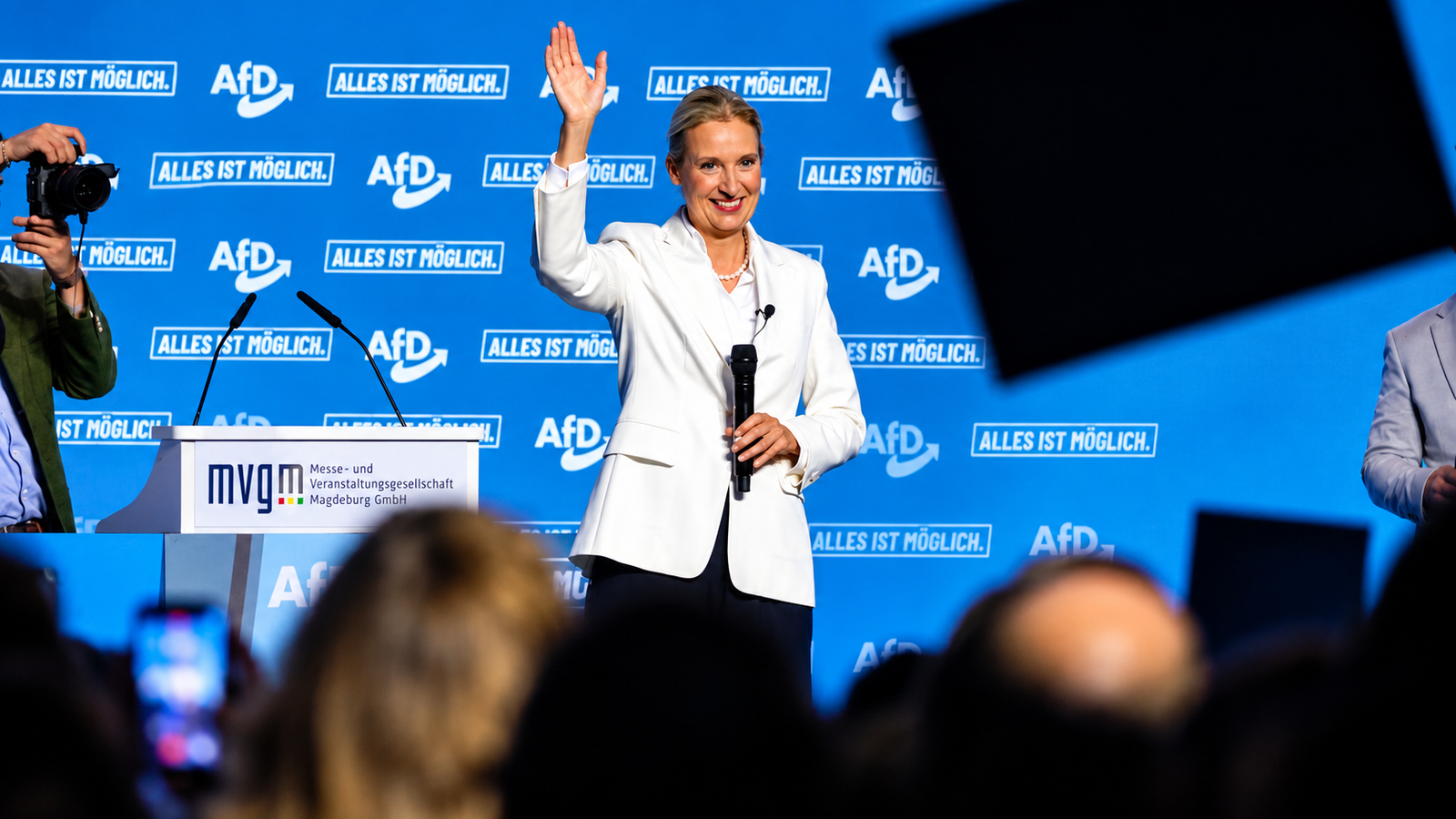
There is a particular kind of silence that says more than a speech. On Sunday night, it belonged to Friedrich Merz. As the results rolled in from Saxony-Anhalt, Germany’s chancellor left his party’s headquarters just after ten o’clock, said nothing to the cameras waiting outside, and disappeared into a black car. A few kilometers away, in Magdeburg, the opposite was happening. A hall full of Alternative for Germany supporters was on its feet, chanting, hugging, filming each other for a night they’d remember. Somewhere in that gap between a chancellor who couldn’t find the words and a crowd that couldn’t stop making noise is the real story of what just happened in Germany.
The numbers alone are startling enough. The AfD took 43.8% of the vote, more than doubling its 2021 result and finishing over 25 points ahead of Merz’s own Christian Democrats, who fell to a historic low of 17.2%. Turnout hit 77.8%, the highest this state has ever recorded. People who had stopped bothering to vote came back specifically to deliver this result. That’s not a party sneaking through on low turnout and apathy, the usual explanation reached for when populist parties win. This was a deliberate, crowded, unmistakable message.
And yet this is the detail most first-day headlines skated past the AfD didn’t actually win power. It landed 39 of 83 seats, three short of an outright majority, and every other party in the parliament has so far refused to govern alongside it. Germany’s domestic intelligence service classifies the state’s AfD branch as a confirmed right-wing extremist organization, a designation the party rejects but hasn’t managed to overturn. So the truthful sentence is a strange, uncomfortable one to hold in your head at once: the AfD has never been closer to running a German state since the Second World War, and it still isn’t running one. History was made and postponed in the same evening.

Here Is Three Companion Pieces on Germany’s Political Moment
1. The Immigration Debate in Saxony-Anhalt: What the Numbers Actually Say
There’s a detail about Saxony-Anhalt that surprises almost everyone hearing it for the first time: it has one of the lowest shares of immigrants of any German state. By the end of 2025, roughly 193,000 people with foreign citizenship lived there in a state of about 2 million. That’s not the demographic picture you’d expect from a region where anti-immigration politics just delivered a historic landslide.
So what’s actually driving the vote? The honest answer is layered, and neither side’s shorthand captures it cleanly.
The economic backdrop. Saxony-Anhalt sits in what was East Germany, and thirty-five years after reunification, the old east-west gap hasn’t closed the way many hoped. Outside a handful of university and tourist cities, much of the state has stagnated economically while younger, more mobile residents move west or to booming pockets like Berlin and Leipzig. Analysts have drawn direct comparisons to America’s Rust Belt: long-term economic decline, a shrinking and aging population, and a political reaction that arrives even when the trigger immigration is objectively smaller here than almost anywhere else in the country. The immigrant population has nearly doubled over the past decade, but it’s doubling from a low base in a place that’s simultaneously losing its own young people to internal migration.
The genuine policy tension. This is where the two sides talk past each other. State labor-market researchers describe Saxony-Anhalt as a place that is “in demand, needed, yet not wanted” meaning employers are increasingly dependent on immigrant labor to fill jobs an aging, shrinking workforce can’t cover, while a meaningful share of the population remains uneasy about the pace of that change. Both things are true at once: the state’s own economic planning documents treat continued immigration as necessary for the labor market, and a large bloc of voters experiences that same trend as loss of familiarity and control. That’s not a contradiction anyone is lying about, it’s simply two real, conflicting pressures sitting on top of each other.
How AfD voters frame it. For many who backed the party, this was never really about Saxony-Anhalt’s specific immigrant numbers, it’s about the national picture since 2015, welfare and housing pressure in already-struggling towns, and a sense that concerns raised for a decade were dismissed rather than addressed. Local integration debates over language requirements in schools, benefits eligibility, and crime reporting all get folded into one larger grievance: that migration policy was decided nationally and in Brussels, with no real consent from towns living the consequences.
How critics and integration researchers frame it. They point out that Saxony-Anhalt’s low immigrant share undercuts the idea that the state is being “overwhelmed,” and that the underlying disease is economic abandonment, not migration with a discontent that would exist with or without a single new arrival, because it’s fundamentally about decades of population loss and limited investment. They also note that immigrant communities in the state are visibly organizing in business associations, churches, and local councils, trying to build the same civic participation the state’s own labor market needs.
The uncomfortable truth sitting underneath both arguments: Saxony-Anhalt may be a test case for how much a feeling of change amplified nationally, discussed constantly, but experienced locally in smaller doses can outweigh a place’s actual demographic reality when people are already anxious about everything else in their lives.

They played New German ‘Remigration’ song ‘Wir schieben sie alle ab!’ Or “We will deport them all.”
2. Is “Far-Right” a Fair Label or a Conversation-Ender? The Media Debate, Examined
Every time a headline reads “far-right AfD,” a fight breaks out over whether that’s reporting or editorializing. It’s worth examining honestly, because both sides have a real case.
The case that the label is accurate, not biased. This isn’t a term invented by unfriendly newsrooms. Germany’s domestic intelligence service, the body responsible for tracking constitutional threats, not a newspaper has formally classified the Saxony-Anhalt AfD branch, along with several others, as a “confirmed right-wing extremist” organization, a designation with a legal evidentiary basis that the party has fought and lost in court in some instances. Reporters Without Borders has also documented a sharp rise in physical attacks on journalists in Germany, with a notable share tied to far-right rallies and conspiracy movements which, press-freedom advocates argue, makes accurate labeling a safety and accountability issue, not a rhetorical one. From this view, softening the term wouldn’t be neutral; it would be inaccurate.
The case that it’s overused as a thought-terminator. German media critics not fringe voices, but figures like sociologist Harald Welzer and philosopher Richard David Precht, whose bestselling book accused leading outlets of drifting from differentiated reporting toward opinion-shaping argue that once a party or its voters are branded “far-right,” the label often does the thinking for the reader instead of prompting it. A group of public broadcasting journalists themselves published an internal manifesto warning about narrowing viewpoint diversity in German newsrooms. Critics note a telling pattern: structural criticism of media coverage gets reflexively associated with right-wing conspiracy thinking, which they argue proves the very point being made, since it treats disagreement as something to be discredited rather than answered.
The genuine complication. Both things can be true simultaneously. A classification can be legally and factually grounded and still be applied in headlines with a flattening effect that erases the difference between “someone who voted AfD over frustration with housing costs” and “a movement under intelligence surveillance.” NPR, CNN, and other outlets that call the AfD “far-right” are reporting a documented institutional fact. Readers who feel the label is used to dismiss their concerns without engaging them also have a legitimate grievance about how coverage is often structured. The failure isn’t usually in the word itself, it’s in coverage that uses the label as a substitute for explaining why millions of ordinary people, in a democracy with free elections, are voting for a party carrying that classification.
The most honest position available to a reader is this: distrust any source, of any political stripe, that thinks the label alone settles the argument.
3. Merkel’s 2015 Decision: What Actually Happened, and How History Has Judged It
To understand why Germany’s politics look the way they do in 2026, you have to go back to a single, specific week.
What she actually did. On September 4–5, 2015, facing tens of thousands of refugees mostly fleeing Syria, Afghanistan, and Iraq stranded at Hungary’s borders, Chancellor Angela Merkel chose not to turn them back, effectively suspending enforcement of the EU’s Dublin rules requiring asylum-seekers to register in their first country of entry. On August 31, 2015, before a bank of cameras, she said the phrase that would define her chancellorship: “Wir schaffen das” “we can do this.” Germany went on to register roughly 1.2 million asylum applications across 2015 and 2016, the largest intake of any European country in that crisis.
What she said the goal was. Merkel framed it explicitly as a humanitarian and moral necessity, not a demographic strategy Germany, in her words, was a strong enough country to manage a crisis of this scale, and turning away people fleeing war wasn’t compatible with the country’s values or legal obligations. Researchers who’ve studied the decision closely note there may not have been a clean alternative available at that moment: the EU’s existing asylum architecture had already effectively broken down at the Hungarian border, and the choice was less “open the doors or don’t” than “manage an already-uncontrolled situation or let it become more chaotic.”
How it’s judged now, across the political spectrum. The retrospective picture is genuinely split, and not along the lines either side expects.
Economists and integration researchers point to outcomes that were less catastrophic than predicted: contrary to warnings at the time, the arrivals did not collapse Germany’s welfare system, and over the following years a large share entered the labor market slower than optimists hoped, faster than pessimists feared. That’s the case supporters make: the “doom-mongers,” as one retrospective analysis put it, were largely proven wrong on the economic collapse question.
Critics make a different, more political argument: that regardless of the economic outcome, the decision was made unilaterally, with limited consultation of Germany’s EU partners or its own states and municipalities that had to absorb the practical burden, and that it directly fueled the AfD’s initial breakthrough into German politics, a party that had been polling in single digits before 2015 and hasn’t left the political landscape since. Even Merkel herself, by 2016, said she wished she hadn’t repeated the phrase as often as she did, calling it “a little overstated.”
There’s also a narrower, more technical dispute among migration scholars: did “Wir schaffen das” itself cause people to choose Germany over other destinations, or was the continent-wide surge already happening regardless of what Merkel said? The most careful academic reviews conclude the phrase probably didn’t cause the crisis, but plausibly influenced where people within that crisis chose to go.

Why it still matters in 2026. Every argument happening in Magdeburg right now is, in some sense, a delayed echo of that week in 2015 refracted through a decade of subsequent Ukrainian refugee flows, EU relocation fights, and Germany’s own repeated failure to build durable political consensus on migration. Whether you view Merkel’s decision as a moral high point or a founding error of Germany’s current instability, both readings agree on one thing: it was the moment German politics stopped being able to avoid the question, and hasn’t found a stable answer since.
It’s tempting, and lazy, to read this purely as ideology winning converts. Talk to the coverage coming out of the region and a duller, more human explanation keeps surfacing: cost of living, strained public services, a sense that decisions about who arrives and who pays get made somewhere far away and never explained. Lead candidate Ulrich Siegmund told a national broadcaster that voters were sending a signal that things couldn’t continue as they were and then, almost as an aside, thanked Merz for being the campaign’s best asset. It stung because it wasn’t entirely wrong. A chancellor whose popularity has been sliding nationally gave his opponents a foil practically for free.
Here’s where the story gets genuinely interesting, and where most single-country coverage runs out of curiosity. If this were the tidy, unstoppable rise of a pan-European nationalist wave, you’d expect the loudest cheers to come from France, where Marine Le Pen’s National Rally has spent a decade building exactly that alliance. Instead, near silence. Le Pen and her heir apparent said nothing publicly. It was Éric Zemmour’s smaller, sharper-edged Reconquête party that celebrated openly, calling the result “the hour of truth,” while Spain’s Vox and Portugal’s Chega sent quick congratulations online. Meanwhile France’s own government ministers reached for the opposite language entirely a “grave moment for Europe,” a “very, very worrying signal.” What looks from a distance like one European right marching in step is, up close, a family arguing about how far is too far and some of its most prominent members would rather not be photographed at this particular party.
That contradiction is worth sitting with, because it undercuts the two simplest narratives on offer. It isn’t “Europe is turning far-right,” full stop the continent’s most electorally successful nationalist, Le Pen, kept her distance. And it isn’t “nothing to see here,” either a state government has never sat this close to extremist classification and this close to power at the same time. The reality is messier than either headline: an anxious, divided political landscape where alliances are calculated more by ambition than by shared conviction, and where even sympathetic parties are doing the math on how association might cost them votes elsewhere.
What should worry the people currently celebrating, and reassure the people currently alarmed, is the same fact: winning an argument about frustration is not the same as winning an argument about governing. The AfD has proven it can channel discontent into votes at a scale nobody predicted. It has not yet had to prove it can run a health system, negotiate a budget, or hold a coalition together under scrutiny, the far duller tests that eventually separate protest movements from governments. Saxony-Anhalt will be one of the first places in Europe where that test might actually arrive.
For now, the more honest headline isn’t “the far right wins” or “democracy in danger.” It’s smaller and stranger than either: a state voted, in record numbers, for the option nobody expected to matter this much and the people who should have the clearest opinion about what that means, from Berlin to Paris, mostly went quiet instead.
Bharatnewsupdates International Insight Team ⊥ September 2026, 8