

The Handshake That Said Everything: Modi, Trump, and the Quiet Unravelling of a “Strategic Partnership”
When two leaders who once embraced like old friends at a Houston stadium in front of 50,000 people reduce their greeting to a formal handshake on the sidelines of the G7 in France that is not body language. That is policy.
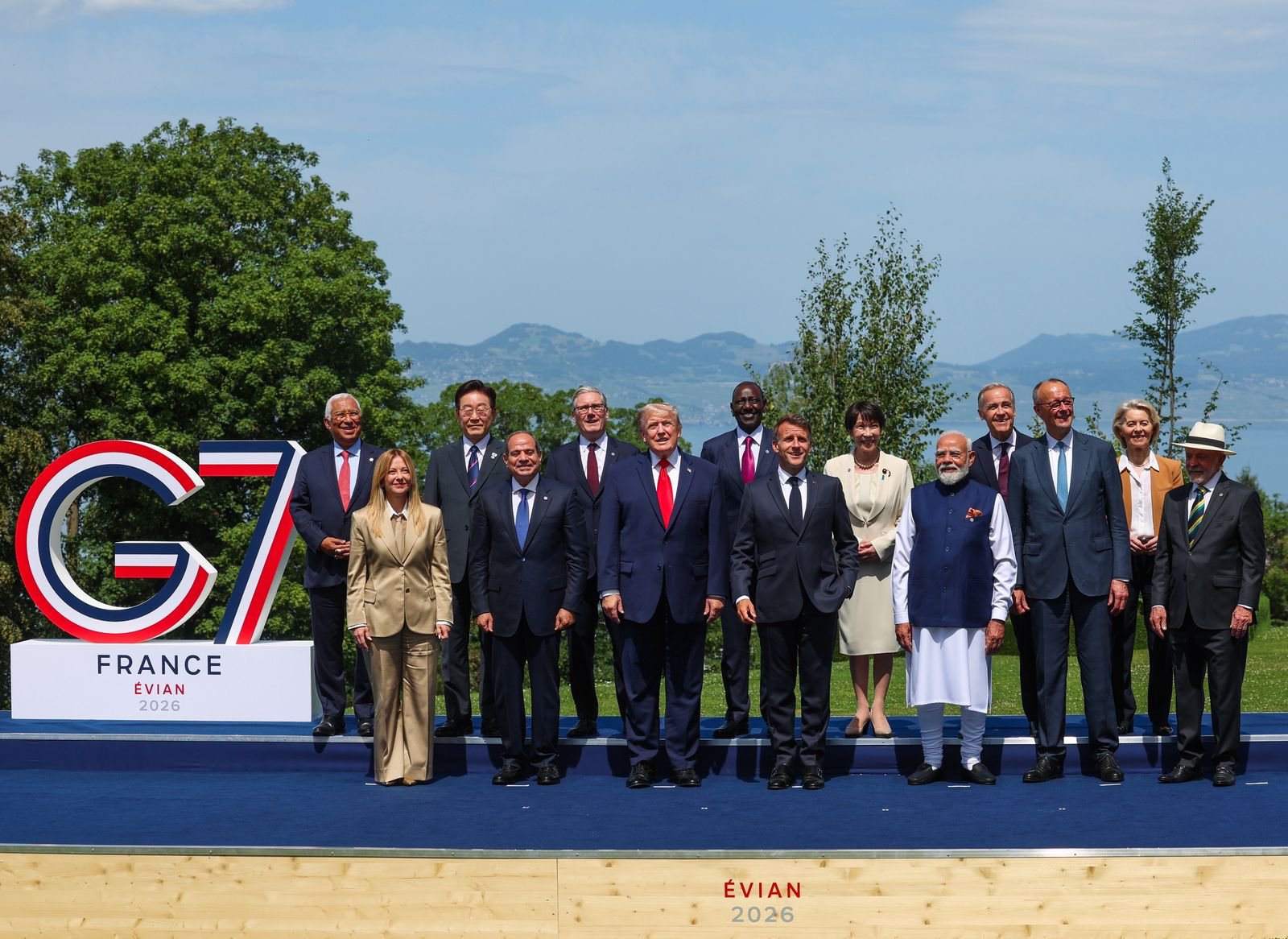
Prime Minister Narendra Modi and President Donald Trump met briefly at the 52nd G7 Summit in Évian-les-Bains on June 17, 2026. No bear hug. No “Howdy, Modi.” No theatre. Just a handshake, a brief exchange, and two leaders who clearly had to work at being civil. If you read only that image and nothing else, you would already understand the state of the US-India relationship better than ten diplomatic press releases combined.
A Relationship Running on Fumes
Let’s not sugarcoat this. The India-US relationship in mid-2026 is not in crisis the way a street brawl is a crisis. It’s more like a slow-motion structural failure the kind where both parties keep issuing reassuring statements while the cracks grow underneath.
The accumulated pressure points are formidable. Trump imposed punitive tariffs on Indian exports. Then came Operation Sindoor in May 2025, when India struck terror infrastructure inside Pakistan and Trump, bizarrely, claimed personal credit for the ceasefire, wounding Indian pride in ways that official statements can’t fully hide. US Secretary of State Marco Rubio made a repair visit to New Delhi, but the reset barely had time to breathe.
Then three Indian seafarers Aditya Sharma, Shivanand Chaurasiya, and Patnala Suresh died when US Navy forces struck the oil tanker MT Settebello off the coast of Oman last week, part of a broader naval blockade enforcement operation amid the 2026 Iran war. India summoned the US Chargé d’Affaires twice. The Ministry of External Affairs called the strikes unacceptable. Modi himself reportedly raised the seafarers’ deaths directly with Trump at G7. These are not the conversations two close allies have. These are the conversations two nations have when they’re deciding how close they actually are.

The “Indo” That Disappeared
On the same day PM Modi and President Trump met in France, the US Department of War yes, they renamed that too quietly announced that the US Indo-Pacific Command would revert to its original designation: US Pacific Command, or USPACOM.
The official explanation was heritage. The 1947 vintage name. Military tradition. Nostalgia for the Truman era.
Here is what nobody wants to say plainly: when James Mattis renamed the command in 2018, he specifically cited the “increasing connectivity between the Indian and Pacific Oceans” and India’s growing strategic weight. It was a diplomatic gift, widely understood in New Delhi as Washington validating India’s central role in the Indo-Pacific framework. Removing “Indo” from the name doesn’t eliminate that reality, but it removes its symbolic acknowledgment. And in diplomacy, symbolism is often the real currency.
A former Indian foreign secretary, quoted anonymously, framed it precisely: the shift is consistent with a broader reorientation in Trump’s National Security Strategy less Indian Ocean, more Pacific theatre. China containment remains the mission, but India’s centrality to that mission is being quietly renegotiated.
Shashi Tharoor, never one to mince words, asked on social media whether this was “one more nail in the coffin of the Quad.” That’s an overstatement, the Quad isn’t dead. But it’s a fair question about direction.
And then there’s the map. On the same day as the renaming, the US Pacific Command released a graphic showing Pakistan-Occupied Kashmir as part of Pakistan, the very territory India regards as its own illegally occupied land. The timing, hours after the Modi-Trump G7 meeting, was not accidental to Indian observers. In February 2026, when the US Trade Representative shared a map showing entire J&K including PoK as part of India, Pakistan protested and the US deleted the post. Now, the military command publishes the opposite. Washington is speaking in multiple, contradictory cartographic tongues. That’s not oversight. That’s hedging.
India’s Blunt Message to the West: Stop Playing Donor
Away from the bilateral friction, Modi delivered what may be the most strategically significant speech India has given at a G7 forum in a decade. Speaking at the Outreach Session on “Forging New Partnerships and Rebuilding International Solidarity,” he told the assembled leaders of the world’s richest economies something they rarely hear directly:
“Mutual trust is the most important strategic asset today. The world should move from donor-recipient to partnerships based on solidarity and equality.”
Strip the diplomatic silk from that sentence and the message is surgical: the era of Western nations extending “aid” to the Global South while extracting compliance is over. India is not asking to be helped. India is asserting the right to be treated as a co-author of the global order.
This was not boilerplate. Modi was seated next to Trump when he said it. He cited India-led initiatives, the International Solar Alliance, the Coalition for Disaster Resilient Infrastructure, the Global Biofuel Alliance, Mission LiFe, the Ek Ped Maa ke Naam campaign not as philanthropy, but as proof that developing nations can lead global problem-solving when the West stops monopolizing the podium.
The philosophy he invoked Vasudhaiva Kutumbakam, the world is one family sounds soft. But its political application is sharp: if the world is one family, then no member of that family gets to dictate to the others from a position of inherited superiority. That is a direct challenge to the donor-recipient dynamic that has defined North-South relations since decolonization.
The Hidden Reality: India Is Building Its Own Table
Here’s what most coverage misses: India’s G7 positioning is not about reacting to the US. It’s about engineering a parallel track.
Consider the geometry of Modi’s bilateral meetings in Évian alone, Germany’s Friedrich Merz, Kenya’s William Ruto, Egypt’s Abdel Fattah el-Sisi, Japan’s Sanae Takaichi, South Korea’s Lee Jae-Myung. This is not a leader seeking reassurance from the West. This is a leader building a simultaneous network that doesn’t depend on any single power’s goodwill.
India’s GDP is projected to become the world’s third largest within this decade. It has the world’s largest population, a young demographic, and the fastest-growing digital economy. It does not need Washington’s permission to have a foreign policy. What it does need is to signal: credibly, repeatedly, without flinching that strategic autonomy is not just a phrase in MEA briefings, but an operational reality.
The handshake with Trump, read correctly, may actually be a feature, not a bug. It says: India can sit next to the most disruptive American president in modern history, maintain composure, raise grievances directly, and walk away with its position intact. That requires more discipline than a hug.
The Trade Talks: Suspended Animation
On India-US trade negotiations, expect extended turbulence. The tariff disputes pre-date the seafarers’ deaths and the naming drama. With those now added to the equation, any trade deal that involves Indian political concessions becomes domestically radioactive for New Delhi.
Here’s the contradiction nobody discusses: India needs US market access for technology, defense equipment, and semiconductor supply chains. The US needs Indian manufacturing capacity as a China alternative. Both sides have enormous incentive to deal. But Trump’s transactional instincts and India’s civilizational pride are a combustible combination. Every time Washington makes a unilateral move, maritime strikes killing Indian nationals, maps drawn wrong, military commands renamed, it deposits another obstacle into the negotiating room that Indian diplomats then have to spend political capital removing before the actual trade conversation can resume.
A deal is possible. But it won’t happen on Trump’s timeline. And it won’t happen on terms that look like capitulation. India has already demonstrated, post-Operation Sindoor, that it can absorb external pressure and act independently. That changes the negotiation calculus fundamentally.
What This Really Shows: A Quiet Pivot in Global Messaging
Is India making a play for global leadership? Not in the G7-presidency sense. In the framing sense. The message Modi delivered in Évian trust over transactions, dignity over dependency, humanity first is a framework India is deliberately positioning as the alternative to both American unilateralism and Chinese debt-trap infrastructure.
The world, genuinely exhausted by both, may be listening more carefully than usual.
The trust deficit between India and the US is real. It is not irreparable. But it requires Washington to understand that India’s strategic partnership is not a subordinate relationship, it is a negotiated one, premised on mutual respect. Every cartographic insult, every unilateral naval strike killing Indian nationals, every symbolic deletion of “Indo” from a command name deposits into a ledger that New Delhi keeps very carefully.
The handshake in France was not hostility. It was honesty. And sometimes, that’s more valuable than the theatre of warmth.
“In a world that is getting more interconnected and interdependent than ever before, mutual trust is the most important strategic asset today.” PM Narendra Modi, G7 Outreach Session, Évian, June 16, 2026
Bharatnewsupdates International Insight Team ⊥ June 2026, 18