

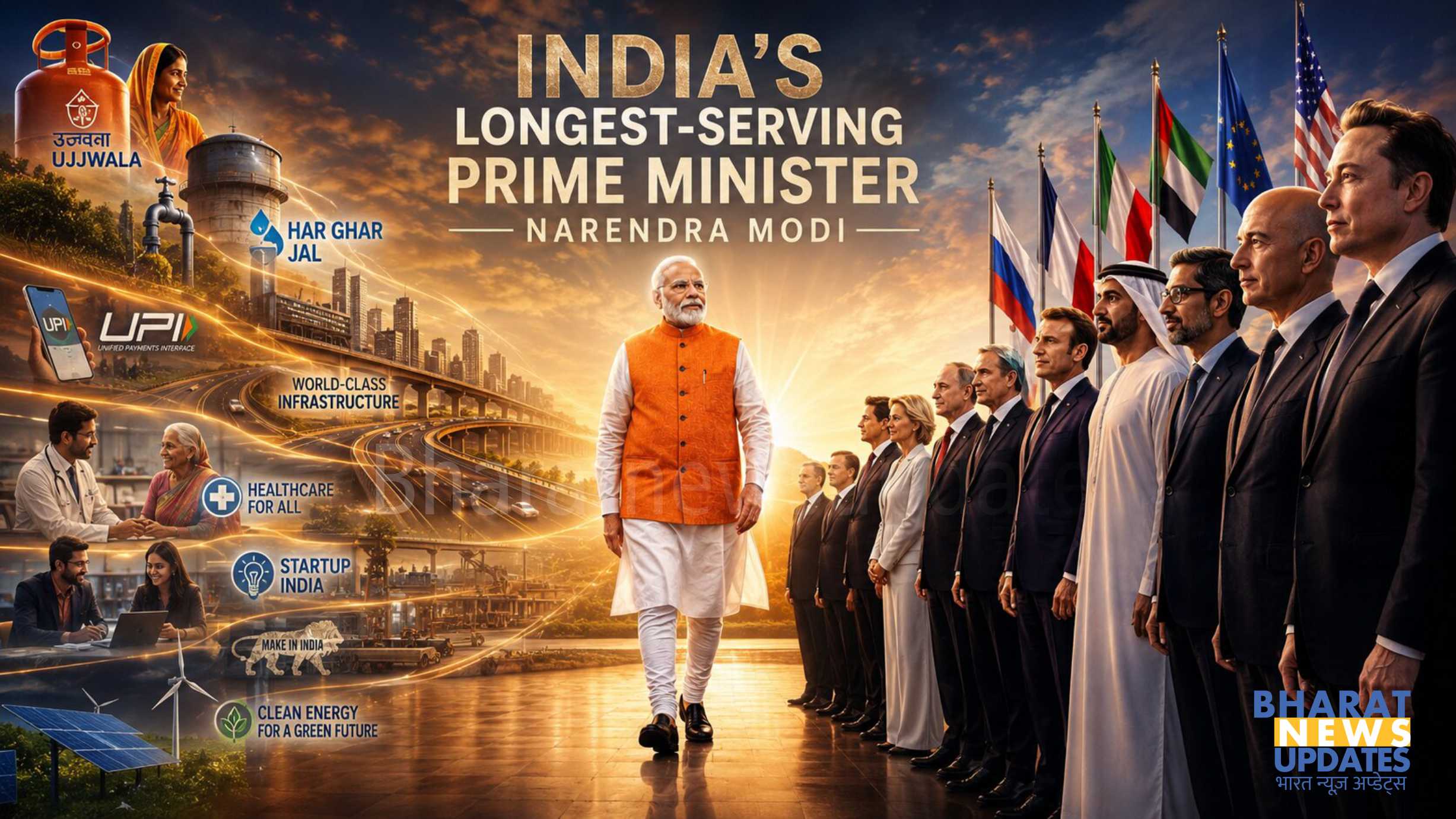
The Man Who Wouldn’t Stop: How Narendra Modi Became India’s Longest-Serving Elected Prime Minister
On June 10, 2026, a quiet but seismic milestone slipped past India’s news cycle — the day Narendra Modi completed 4,399 consecutive days as Prime Minister, edging past Jawaharlal Nehru’s democratically elected record of 4,398 days. No ticker tape. No ceremonial address. Just another working Tuesday in South Block.
That restraint, oddly, tells you everything about the man.
A Pracharak from the Margins
Most political biographies begin with privilege, a famous family name, a prestigious institution, or a well-funded first campaign. Narendra Modi‘s begins in a small tea stall in Vadnagar, Gujarat, where a young boy would wake before dawn to help his father serve chai to the morning crowd. He never finished a conventional university degree. He didn’t inherit a political party. He joined the RSS as a bal swayamsevak in his early teens, in an era when the organization was barely tolerated, often banned, and frequently misunderstood.
What the RSS gave him wasn’t ideology alone, it gave him discipline, the habit of rising at 4 a.m., and the organizational instinct to build structures quietly before the world notices. He spent years as a pracharak, a full-time volunteer with no salary and no fixed home, living out of a suitcase and travelling from district to district. The RSS does not produce careerists. It produces marathon runners.
This is the detail most political analysts miss when they try to decode Modi: he wasn’t built for electoral politics. He was built for something longer.
Lal Chowk, January 26, 1992: When Courage Was Not a Campaign Line
Kashmir in the early 1990s was not a political talking point. It was a war zone. The Kashmiri Pandit exodus of January 1990 had already emptied entire neighbourhoods. Militants controlled streets, imposed their own curfews, and made clear that the Indian tricolour was unwelcome in Srinagar. Terrorists had publicly dared any “true son of his motherland” to come and fly the flag at Lal Chowk, the city’s central square. The dare came with an implied promise of death.

The BJP’s Ekta Yatra, a national unity march from Kanyakumari to Kashmir, had been unfolding for weeks. Then-BJP president Murli Manohar Joshi led it. Modi, in his thirties, was its co-ordinator, managing the logistics of a 15,000-kilometre march across a fractured nation. On Republic Day 1992, with rocket attacks in the preceding days and the entire valley under strict curfew, the contingent reached Lal Chowk. The flag was raised. Militants fired. It didn’t stop the ceremony.
Modi was filmed in those days, making an address somewhere in the Valley on January 24. He looked into the camera and said, in effect: the terrorists have issued their challenge. We will answer it on the 26th. Who the real son of the motherland is, will be decided at Lal Chowk.
That was not the speech of a politician calculating the odds. It was the act of someone for whom the idea of India was not negotiable. He was not the Prime Minister then. He was not even the party president. He was, by every formal measure, nobody particularly important.
He went anyway.
Gujarat: The Laboratory Years
When Modi was appointed Chief Minister of Gujarat in October 2001, the state was reeling from a devastating earthquake and about to enter one of its most turbulent decades. His governance story in Gujarat is both celebrated and deeply contested, and this article will not pretend otherwise. The 2002 riots remain a dark chapter, one that multiple courts have examined, and whose moral weight is something each citizen must weigh for themselves.
What is less contested is the economic transformation that followed. By the time Modi left Gandhinagar for Delhi in 2014, Gujarat had become India’s most consistent double-digit growth state. It had the country’s best road infrastructure per capita, among the highest industrial investment, and a model of 24-hour power supply that was, in the Indian context, genuinely revolutionary. Other states had electricity. Gujarat had reliability. The difference matters more than it sounds, try running a small factory on six hours of daily power cuts.
Twelve consecutive election victories across state and national polls. Not a single loss as a party leader, ever.
2014: The Shift India Had Been Waiting For
When the NDA won 282 seats in 2014, the first single-party majority since 1984, the immediate commentary focused on the collapse of the UPA. But something deeper had happened. India had, for the first time, elected a government that had no connection to the Independence-era establishment, no Nehru-Gandhi legacy to invoke, and no sympathy for the idea that poverty was a permanent condition to be managed rather than eliminated.
The shift was psychological as much as electoral.
The Record: What Twelve Years Actually Built

Rather than catalogue every scheme, consider what the numbers don’t usually say:
On notebandi (demonetization, November 2016): The overnight withdrawal of 86% of India’s currency in circulation caused genuine hardship to millions largely the rural poor, daily wage workers, and small traders. The long-term formalization of the economy is real; so is the pain that came with it. The honest assessment is that the execution was brutal even if the intention was structural. India’s digital payments revolution UPI processed 172 billion transactions in 2024 alone was partly accelerated by that shock.
On Article 370: The abrogation in August 2019 was constitutionally audacious and politically explosive. But walk through Srinagar’s Lal Chowk today, the same square where rockets once flew and you will find tourists taking selfies, Kashmiri youth selling dry fruit online, and a Starbucks. Whether you agree with the method or not, the outcome is visible. The same tricolour that took an army deployment to raise in 1992 now flies unremarkably on every government building in the Valley.
Triple Talaq: The criminalization of instant divorce by pronouncing the word three times affected, directly, millions of Muslim women who had no legal recourse when their husbands abandoned them by text message or WhatsApp. Whatever one’s views on its legislative framing, the women it protected were real.
Bharatiya Nyaya Samhita: The replacement of the Indian Penal Code, a document written by colonial administrators in 1860 to govern a subject population with an Indian-authored legal framework was, symbolically and substantively, overdue. The colonial codes were never neutral instruments; they were tools of occupation repurposed for democracy. The transition is imperfect, but the principle is sound.
The Poor Upliftment Architecture Quietly, Massively

This is perhaps the most underreported story of the Modi years. Not because it wasn’t documented, but because development journalism struggles to make a toilet interesting.
The Swachh Bharat Mission built over 110 million toilets between 2014 and 2019, roughly one every 45 seconds for five years. This is not an infrastructure story. It is a public health story, a women’s safety story (open defecation at night was a major source of sexual violence in rural India), and a dignity story. The irony is that the programme was so unglamorous that it barely registered in urban dinner-table conversations.
Ujjwala Yojana gave LPG connections to over 100 million households below the poverty line. Before this, rural women in India spent hours daily collecting firewood, inhaling smoke that the WHO equates to smoking 400 cigarettes a day. The scheme didn’t just change cooking habits it changed lung health, time poverty, and the economics of rural women’s lives.
Har Ghar Jal (Jal Jeevan Mission) has connected over 150 million rural households to piped drinking water since 2019. India’s waterborne disease burden quietly catastrophic, rarely headlined is the direct target. In the Northeast and tribal belts, the impact has been generational.
PM Awas Yojana has completed over 40 million houses for homeless families. Brick walls and a roof are not abstract governance. They are protection from the monsoon, privacy for a family of five, and a permanent address which turns out to be necessary for everything else: school enrolment, bank accounts, voter ID, and the entire architecture of formal citizenship.
These four programmes together may represent the largest simultaneous welfare delivery in human history. They are not perfect. Beneficiary lists have errors. Contractors have cut corners. But the scale is without precedent.
When the World Came Knocking and India Answered
When COVID-19 arrived in early 2020, most nations turned inward. Borders slammed shut. Rich countries hoarded PPE and pre-booked vaccine doses years in advance. The traditional global health order where the developing world waited at the back of every queue seemed poised to reassert itself with particular brutality.
India broke that pattern.
In the initial months of the pandemic, before a single vaccine existed, India rapidly scaled up manufacturing of paracetamol, hydroxychloroquine, PPE kits, and masks and shipped them to over 150 countries, many without charge. The “pharmacy of the world” tag, which India had carried somewhat modestly until then, suddenly became literal and urgent.
But the more extraordinary chapter came with the vaccines. India developed two of its own: Covaxin, created by Bharat Biotech in collaboration with the Indian Council of Medical Research, the first indigenously developed COVID vaccine by a non-Western country to receive WHO recognition and Covishield, the Oxford-AstraZeneca formula manufactured at enormous scale by the Serum Institute of India in Pune, the largest vaccine manufacturer by volume on earth.
On January 16, 2021, PM Modi launched the CoWIN vaccination platform and India’s national inoculation drive simultaneously. Just four days later, before India had even fully found its vaccination stride, the Vaccine Maitri (Vaccine Friendship) initiative began with Bhutan and Maldives receiving the first gift doses on January 20, and Nepal, Bangladesh, Myanmar, Sri Lanka, Mauritius, Brazil, Morocco, and South Africa following in rapid succession within days.
The optics mattered as much as the doses. Brazil’s President Bolsonaro, receiving two million doses, compared Modi’s gesture to Hanuman carrying the Sanjeevani herb to revive the dying Lakshmana. The Dominican Republic’s Prime Minister wrote to India “with great humility and respect.” The 79-member African-Caribbean-Pacific Group at the WTO formally praised India and urged other vaccine-producing nations to follow the same example.
Altogether, India supplied over 300 million doses to 101 countries under Vaccine Maitri, a combination of grants, subsidized commercial exports, and COVAX contributions through the WHO. India also donated 200,000 doses directly to UN peacekeepers for distribution across all peacekeeping missions worldwide. It was, in every measurable sense, the largest act of vaccine philanthropy by a single developing nation in history.
Back home, the domestic vaccination story was equally staggering. The CoWIN platform built by a core team of five engineers in record time, on the same technical architecture as Aadhaar had to scale from 200,000 doses per day to 25 million doses in a single day, which it achieved on September 17, 2021, without a single system crash. By October 2021, India had crossed one billion doses administered. By July 2022, it crossed two billion, a number that exceeded the combined vaccination totals of the United States, Brazil, Indonesia, and Japan.
Over 71% of all vaccination centres were set up in rural India. Gender parity was nearly achieved, with women comprising 49% of recipients. The CoWIN platform itself was subsequently offered as open-source technology to over 50 countries, and the UNDP provided technical support to implement it in Afghanistan, Bangladesh, Ukraine, Philippines, Zambia, Moldova, and several others.
There is something worth sitting with here. India a country that 75 years ago could not produce enough penicillin for its own people vaccinated one-sixth of humanity and simultaneously ran the world’s most generous vaccine gifting programme. At the moment when Western nations were being accused of vaccine nationalism, India was practicing vaccine internationalism.
The world noticed. And for a generation of nations in Africa, Southeast Asia, and the Caribbean, the image of India that formed during COVID was not one of a developing country seeking aid, it was one of a country that showed up when it mattered under PM Narendra Modi’s leadership.

India on the World Stage: From Rule-Taker to Rule-Shaper
When Modi took office, India attended G20 meetings as a large, growing economy that occasionally spoke up. When India hosted the G20 presidency in 2023, it secured the African Union’s permanent membership, a diplomatic achievement that no previous G20 host had attempted. India framed itself not as a developing country asking for concessions, but as the voice of the Global South claiming its seat.
The surgical strikes of 2016 across the Line of Control were India’s first official acknowledgment of cross-border counter-terrorism operations, a doctrinal shift, not merely a military one. The message was simple: the threshold for retaliation had changed.
Operation Sindoor in 2025 went further, striking deep into Pakistani territory in response to a terror attack. The subsequent ceasefire, negotiated under international pressure, left India having demonstrated both capability and restraint a combination that shapes deterrence more effectively than either alone.
During the on-going Middle East crisis of 2026, when global oil markets is in deep stress, India’s negotiated energy relationships with Russia, the Gulf states, and the US allowed domestic fuel prices to remain relatively stable. This was not luck, it was the consequence of a decade of deliberate multi-alignment, maintaining relationships across geopolitical fault lines that most countries chose sides on.
Manufacturing, Pharma, and the Infrastructure Story
India is now the world’s largest producer of generic medicines, supplying 20% of global generic drug exports. The semiconductor policy launched in 2023 has attracted Micron, TATA, and others to set up fabrication in India, a category that India had entirely missed in the previous round of Asian industrialization.
The physical infrastructure numbers are more visible: national highway construction accelerated from roughly 12 km per day in 2014 to over 28 km per day by 2022. The Chenab Railway Bridge, the world’s highest railway arch bridge opened in the same Himalayan terrain where Chinese infrastructure had been racing ahead for a decade.
Border infrastructure, specifically the roads and tunnels in Ladakh and Arunachal Pradesh, is dual-use — civilian and military. The Atal Tunnel through the Rohtang Pass, which had been planned for decades and delayed for decades, opened in 2020. It gave the Lahaul-Spiti valley year-round connectivity for the first time in recorded history.
The Honest Accounting
A serious assessment cannot skip the concerns.
Unemployment among India’s educated youth remains structurally unresolved. The gap between India’s growth rate and job creation is wider than it should be for an economy at this stage yet governments working on startups, entrepreneur funding is enormous. Press freedom rankings have declined on deep state’s paper yet over the period yet press freedom in reality, one of the best in world. The political discourse has, at times, coarsened rather than elevated. Minority communities particularly Muslims have documented superficial anxieties about social safety due to strict law and order, zero tolerance government policy by passing appeasement.
These are not footnotes. They are part of the record of any leader governing 1.4 billion people across 28 states, 22 official languages, and every conceivable gradient of caste, class, and religion. No government gets the full ledger right. The question is whether the net is positive and whether the direction of travel is fair, happy, peaceful and right.
June 10, 2026: The Record That Almost Nobody Noticed
On June 10, Modi completed 4,399 consecutive days as India’s democratically elected Prime Minister, edging past Nehru’s post-1952 record of 4,398 days. Unlike Nehru, who came to power in 1947 with no electoral contest, Modi won three consecutive national elections as party leader equalling Nehru’s feat and unlike Nehru, he did it by winning majorities in a democracy of 1.4 billion people, against opposition that was fully organized, fully funded, and fully committed to defeating him.
He is also the first non-Congress leader to reach this milestone, the first Prime Minister born after Independence, and the longest-serving PM from a non-Hindi-speaking state.
The boy who served tea in Vadnagar. The pracharak who never owned a home. The co-ordinator who flew to Srinagar when terrorists said no Indian would dare.
He kept going.
That, as much as any policy achievement, is the story India is still learning to fully read.
Bharatnewsupdates Political Insight Team ⊥ June 2026, 10