

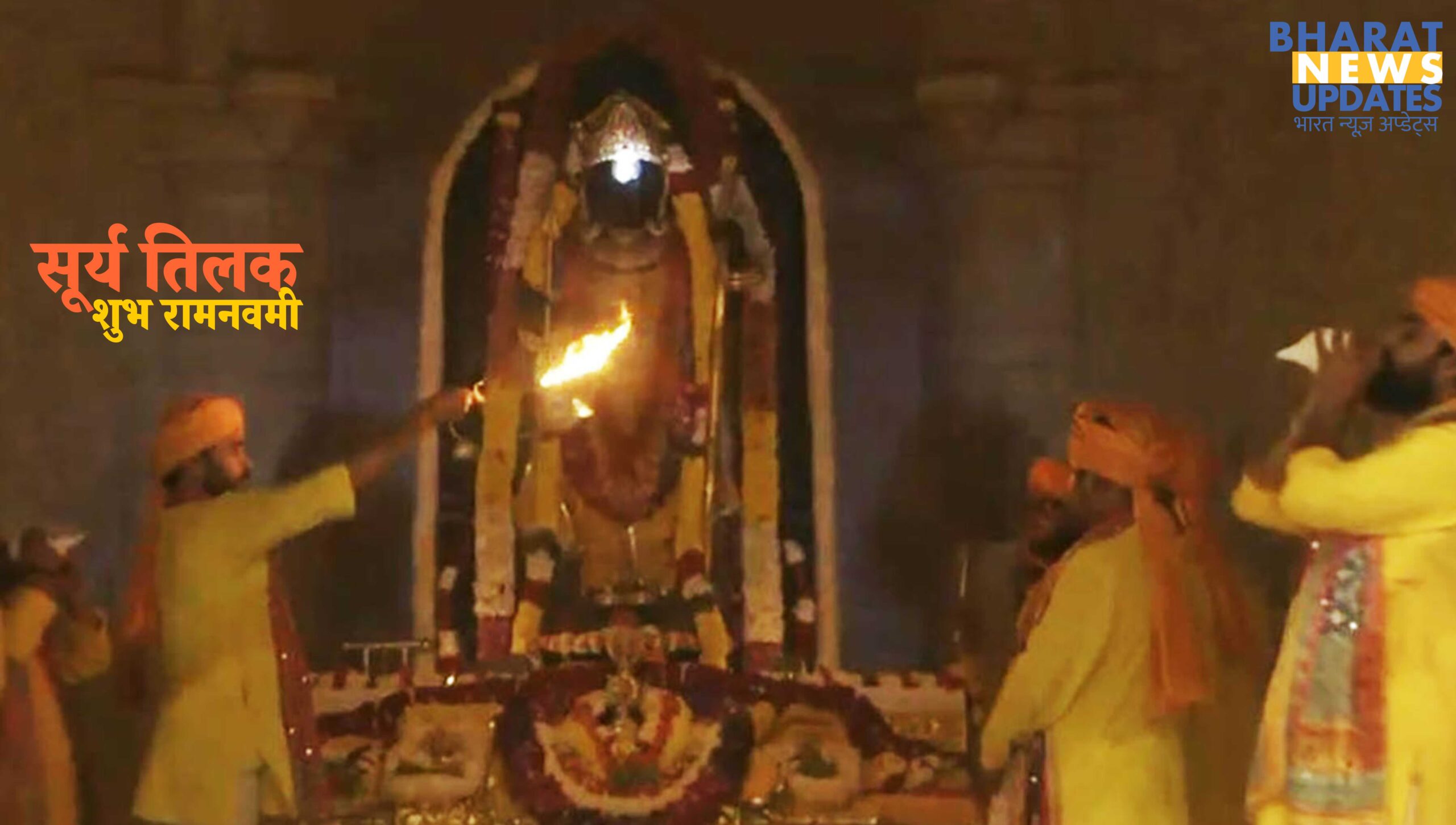
When the Sun Bows to Ram — The Story of Surya Tilak at Ayodhya
Today, on the eve of Ram Navami, as the Navami Tithi draws to its close on the morning of March 27, 2026, Ayodhya is still glowing. The chants haven’t stopped. The diyas haven’t gone out. And somewhere in the heart of this ancient city, a moment that happened just yesterday at the stroke of noon is being spoken of with trembling voices and wet eyes— the Surya Tilak of Prabhu Sri Ram Lalla.
Today, 27th March, the Surya Offered a Tilak
Today, March 27, 2026, at exactly 12:00 PM, something quietly extraordinary took place inside the sanctum sanctorum of the Shri Ram Janmabhoomi Temple in Ayodhya. A slender beam of sunlight — travelling from the temple’s third floor through a precise arrangement of mirrors and lenses— fell gently on the forehead of Prabhu Sri Ram Lalla’s idol. Not for a second, not by accident. But deliberately, accurately, reverently. For approximately four minutes, the Sun itself offered a tilak to the Lord.
The Surya Tilak coincides with the noon aarti. As Gopal Rao, an invited member of the Shri Ram Janmabhoomi Teerth Kshetra Trust, explained: “At 12:00 PM, the Surya Bhagwan has offered a symbolic tilak to Prabhu Sri Ram, who was born in the Solar dynasty. The rays will remain on the forehead for four minutes.”
Surya Tilak, is a ritual that has captured the world’s imagination, not just for its spiritual weight, but for its breathtaking precision.
Prabhu Sri Ram belongs to the Surya Vansha— the Solar dynasty. His lineage traces back to Surya, the Sun God. So when sunlight anoints his forehead on the exact day of his birth, it is not just optics. It is the cosmos honouring its own.
For centuries, Indian temples have been architectural marvels designed to harness sunlight on specific days. The new Sri Ram Janmabhoomi Temple continues this ancient tradition, but with a sophistication that marries Shilpa Shastra (ancient science of craftsmanship) with modern optical engineering.
The Science Behind Surya Tilak — And Why It’s Quietly Astonishing
This is where the story gets interesting, and where most people are told half the truth.
The opto-mechanical system consists of four mirrors and four lenses fitted inside a tilt mechanism and piping system. The tilak size is 58 mm, and the exact period of the tilak on the forehead center is about three to three-and-a-half minutes, with two minutes of full illumination.
The development of the Surya Tilak mechanism involved collaboration between scientists from CBRI Roorkee and the Indian Institute of Astrophysics, Bengaluru. Employing a special gearbox and using reflective mirrors and lenses, the team orchestrated the precise alignment of sunlight rays from the temple’s third floor to the inner sanctum using established principles of solar tracking.
But here is what most people don’t know: the mechanism uses no electricity, no batteries, and no iron-based components. The intricate arrangement involves 19 gears to ensure the timely occurrence of the ritual on Ram Navami, aligning with the lunar calendar. Four high-quality lenses and strategically placed mirrors have been installed, not on the temple roof, but in a specific mechanism that channels the sun’s rays.
Remarkably, the mechanism operates without electricity, batteries, or iron-based components, relying solely on mechanical precision.
Why 19 gears? Because of a beautiful astronomical coincidence. Since a lunar year is shorter than a solar year by nearly 11 days, a specific lunar tithi like Ram Navami shifts to an earlier date in successive years. The Hindu lunisolar calendar applies a correction through Adhik Mas every 2–3 years to bring lunar months closer to the seasons. Detailed calculations show that the English calendar date of Ram Navami repeats every 19 years.
The apparatus includes mirrors, lenses, and a sophisticated gearbox — all made from durable materials like brass and bronze, known for their resistance to corrosion.
The tilt mechanism is used to adjust the first mirror’s tilting for sending sun rays toward the north direction to the second mirror for making the Surya tilak each year on Ram Navami day.
One more thing worth knowing: an annual shift of the first mirror must be performed manually before Ram Navami every year, and the mechanism will not work in the absence of sunlight due to clouds or rain. The scientists chose not to use artificial light as a backup — because the belief was that if it’s going to be a Surya Tilak, it will come from the Sun. Full stop. Yesterday, the sky was clear.
This is not merely science; it is the Rigveda coming to life—the invocation of the sun (Surya) as the visible soul of all creation, blessing the incarnate form of Vishnu.

The Spiritual Meaning Nobody Explains Fully
A tilak on the forehead is not decoration. In the Hindu tradition, the forehead— the ajna chakra— is considered the seat of wisdom, consciousness, and divine sight. When a tilak is applied, it is an act of recognition: I see the divine in you.
When the Sun offers this tilak to Prabhu Sri Ram Lalla, it is Surya Deva recognizing the divine in his own descendant. The Solar dynasty’s ancestor acknowledging the Solar dynasty’s greatest son.
Prabhu Sri Ram is called Maryada Purushottam — the highest among men, the one who upheld dignity even when it cost him everything. Fourteen years in the forest. The separation from Sita. The burden of dharma carried without complaint. The Surya Tilak, in a sense, is the universe saying: we see what you carried. We honour it.
Spiritual texts reveal that chanting the holy name “Rama” on this day cleanses the soul of past karmas and brings profound inner peace.
Aarti Timings at Ram Janmabhoomi Temple
For those in Ayodhya or those who couldn’t make it but want to align their prayers at home, the aarti schedule at the Ram Janmabhoomi Temple is:
| Aarti | Time |
|---|---|
| Mangala Aarti | 4:30 AM |
| Shringar Aarti | 6:30 AM |
| Midday Aarti (with Surya Tilak) | 12:00 PM |
| Shayan Aarti | 9:30 PM |
The Mangala Aarti at 4:30 AM marks the waking of the Lord — the first light offered before dawn even breaks. Many devotees who couldn’t sleep last night simply stayed awake for this. There is something about Ram Navami that makes sleep feel like a loss.

Darshan Timings for Devotees
To manage the extraordinary crowds, the temple trust typically suspends all VIP and Sugam Darshan passes during the Ram Navami period. All devotees must use the general queue system. This is one of those rare spiritual levellers— no queue-jumping, no special passes. A farmer from Sitapur and a businessman from Mumbai stand in the same line.
Free darshan slots are available throughout the day:
- 7:00 AM – 9:00 AM
- 9:00 AM – 11:00 AM
- 11:00 AM – 12:00 PM
- 1:00 PM – 3:00 PM
- 3:00 PM – 5:00 PM
- 5:00 PM – 7:00 PM
- 7:00 PM – 9:00 PM
Prasad distribution has been arranged, and authorities have ensured comprehensive arrangements including drinking water, shaded areas, and facilities for storing belongings.

Ayodhya on Ram Navami— What It Actually Feels Like
From sacred temple rituals and religious processions to the serene Sarayu Aarti, every moment of Ram Navami in Ayodhya offers a powerful spiritual experience.
Before dawn, tens of thousands of people walk to the Saryu River. The ghats fill up quietly. Families, elders, young children sitting on shoulders — all moving toward the water in that particular half-dark that exists between 4 and 5 AM. A holy dip in the Saryu is believed to carry the weight of a lifetime of sins and leave you lighter.
By mid-morning, the city is loud with Ramayana recitations. You’ll hear it from speakers outside temples, from shops, from the corner where an old man has been sitting since before you woke up. The air smells of marigold and incense and the particular sweetness of prasad being distributed on street corners.
The crowning jewel of Ram Navami celebrations at the new Shri Ram Janmabhoomi Temple is the mesmerizing Surya Tilak ritual. This phenomenon lasts for a few magical minutes, aligning the cosmos with the exact moment of the Lord’s birth. For the millions unable to enter the sanctum at that precise moment, the temple trust broadcasts the Surya Tilak live on giant screens installed across Ayodhya, ensuring no devotee misses this breathtaking convergence of science, architecture, and intense devotion.
When the tilak happened yesterday— when that beam of light touched Prabhu Sri Ram Lalla‘s forehead — the chants of Jai Shri Ram that rang through Ayodhya were not planned or coordinated. They simply rose, the way water rises when a dam breaks. Spontaneous. Uncontainable. Ancient.
Jai Shri Ram.