

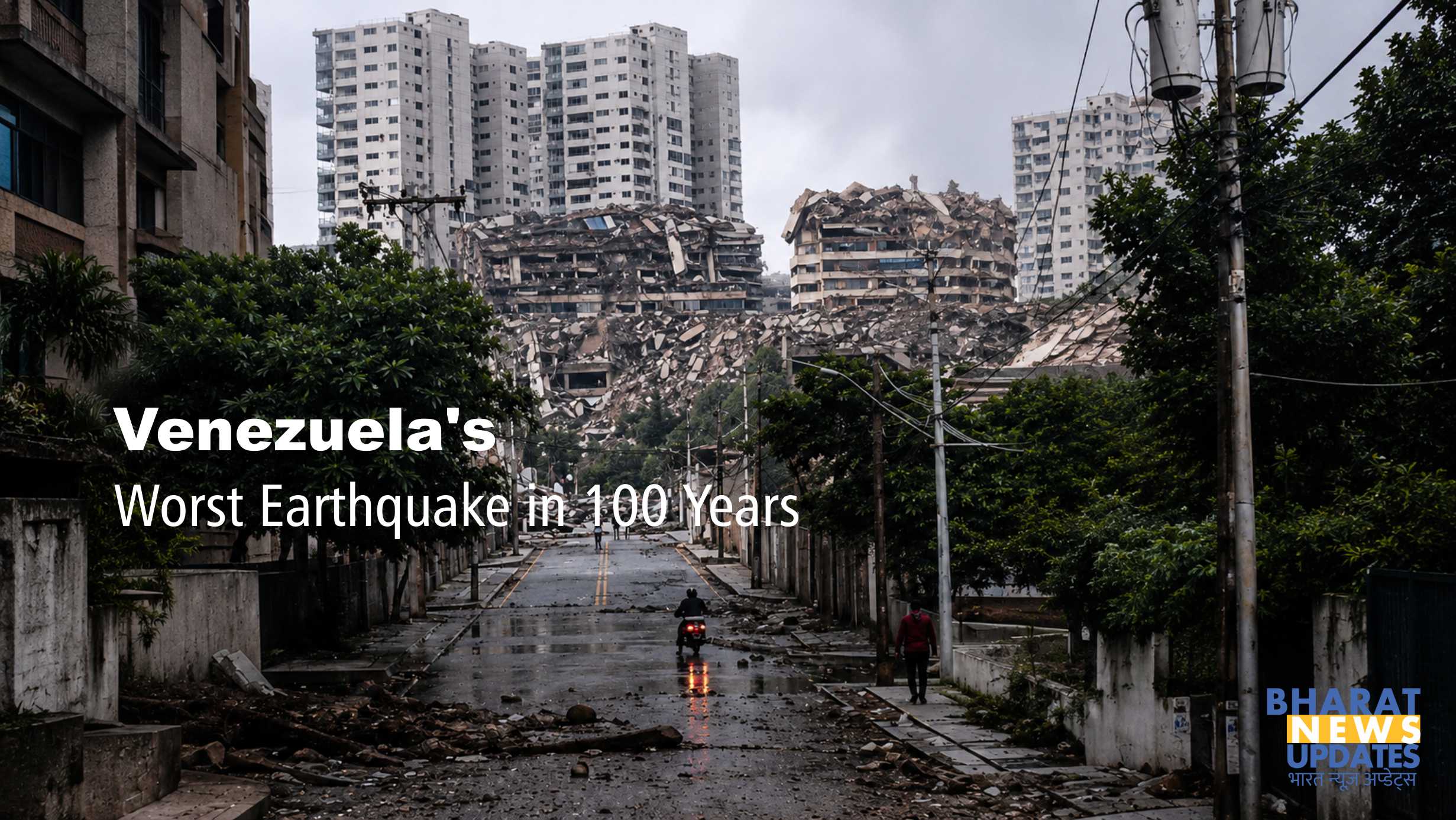
The ground shook twice. Forty seconds apart. And nothing was the same again.
On the evening of June 24, 2026, a Wednesday, a public holiday, a day when millions of Venezuelans were home with their families, the earth beneath their feet betrayed them. Not once. Twice. In rapid succession. In what seismologists are already calling a rare and devastating “doublet” seismic event, Venezuela was struck by earthquakes of magnitude 7.2 and 7.5, just 39 seconds apart, leaving behind a trail of rubble, grief, and an uncertain death toll that experts warn could climb into the thousands or beyond.
As of Thursday morning, acting President Delcy Rodríguez confirmed at least 235 dead and 4300 injured numbers she acknowledged were incomplete, as they excluded La Guaira, the coastal state she described as a “disaster zone.” The US Geological Survey‘s predictive modelling has suggested the final toll will “most likely run into the thousands,” with a substantial probability of exceeding 10,000 lives lost. No official has yet dared say that number out loud. But the rubble tells its own story.

Forty Seconds That Split Venezuela in Two
At precisely 22:04 GMT on June 24, a magnitude 7.2 earthquake struck near San Felipe in the Yaracuy region, approximately 284 kilometres west of Caracas. Thirty-nine seconds later, before most people had even steadied themselves, a 7.5 magnitude mainshock hit near Yumare, 293 kilometres west of the capital, at a shallower depth of just 10 kilometres. Shallow earthquakes are far more destructive: the seismic energy has less earth to travel through and arrives at the surface with brutal, undiluted force.
The 7.5 makes this the most powerful earthquake to strike Venezuela in over a century.
What made this doubly terrifying literally was the sequencing. The 7.2 was no foreshock in the traditional sense. It was enormous by any standard. People who ran from their buildings after the first tremor were still in the streets, looking back at cracked walls and shattered glass, when the 7.5 hit. There was no window of safety. The second quake caught rescue instincts mid-thought.
Dozens of buildings did not simply crack they collapsed.
Why Venezuela Was So Vulnerable: The Hidden Seismic Truth
Here is what official tourism brochures and even geography textbooks rarely highlight: roughly 80 percent of Venezuela’s population lives in seismically active zones, according to US Geology survey. The country straddles the boundary between the South American and Caribbean tectonic plates, a zone of constant, slow-motion geological tension. Strong earthquakes are not common, but when they come, they have been catastrophic.
The last comparable event was in 1812, when a devastating earthquake killed an estimated 30,000 people in Mérida and Caracas. The country was barely a republic then. Today, with a population of over 28 million many living in dense urban areas, the structural vulnerability is of a different, more modern kind.
Venezuela’s buildings tell the story of a country that stopped investing in its infrastructure over a decade ago. Chronic economic collapse, hyperinflation, years of sanctions, and a government more focused on political survival than civil engineering meant that building codes were rarely enforced and renovation was a luxury most could not afford. When the shaking started, older concrete-frame structures in Caracas particularly in the municipalities of Los Palos Grandes and Altamira were among the first to come down. In an unspecified southeastern area of the capital, witnesses and emergency responders described entire blocks of high-rise buildings either heavily damaged or collapsed outright.

La Guaira: The Epicentre of Grief
Of all the places hit, La Guaira the coastal state north of Caracas that houses the country’s main international airport emerged as the single worst-hit zone. Rodríguez declared it a “disaster zone” early Thursday morning and said dozens of buildings had collapsed there, with intensive rescue operations underway. The early death and injury figures released did not even include La Guaira’s casualties, which means the 235 confirmed dead is a floor, not a ceiling.
Television footage broadcast on state media showed three children covered in white dust, eyes wide pulled alive from the rubble in La Guaira. Field hospitals were set up on the streets outside. People were receiving treatment in open air, in improvised triage centres, because formal medical infrastructure had either been damaged or overwhelmed.
Simón Bolívar International Airport, Venezuela’s main international gateway and located in La Guaira, was severely damaged and immediately shut down to all flights, further isolating the country at the moment it needed outside help most.
Other badly affected states included Falcón, Trujillo, Carabobo, Aragua, Miranda, and parts of Greater Caracas. In Falcón’s capital, 32 people were hospitalized and 15 remained trapped more than four hours after the quake. In Chacao, a municipality in eastern Caracas, two structures collapsed entirely, injuring 16 and killing an unspecified number.

The Night People Spent on the Streets
Interior Minister Diosdado Cabello urged residents to remain outside through the night, warning that aftershocks at least 30 were recorded by Thursday morning could bring down already-weakened structures. Venezuelans listened. They sat on pavements, clutching pets, wrapped in whatever they could grab. Some slept in parked cars. Others took shelter in subway stations. In parts of the capital, power was cut, cellphone networks collapsed, and natural gas was shut off as a precaution against fire.
This last detail the cellphone blackout deserves its own sentence of grief. Venezuela has one of the largest diaspora populations in the world: more than 7.7 million people have left the country during its ongoing crisis. For those living in Bogotá, Miami, Madrid, or Mumbai, the silence from Caracas was unbearable. Families with elderly parents, with children, with siblings sitting in foreign cities, refreshing their phones, unable to get through. Network analysis firm NetBlocks reported connectivity dropped to just 59% of normal levels immediately after the quake, recovering only partially to 77% hours later.
The separation of Venezuela’s diaspora from those left behind is one of this disaster’s least-reported dimensions and one of its most human.


The Red Cross, World Vision, and the Reality on the Ground
The Venezuelan Red Cross mobilized immediately, despite suffering critical damage to its own national headquarters. Its nationwide network of hospitals and polyclinics continued to operate through the night. Four rapid-assessment teams were deployed overnight to the worst-hit areas, while prepositioned relief supplies were sent out to affected communities. Volunteers, many of whom were themselves victims of the earthquake, returning home to find their own buildings damaged were out in the streets within hours.
The International Federation of Red Cross and Red Crescent Societies (IFRC) in Geneva confirmed Thursday that the most urgent needs on the ground were search and rescue, emergency shelter, trauma care, and psychosocial support. In the coming days, the focus would expand to safe water, sanitation, and sustained healthcare.
World Vision’s National Director for Colombia and Venezuela, Peter Gape, said the organisation was in constant contact with staff in affected areas. The Global Empowerment Mission (GEM) announced it was deploying recon and emergency response teams expected to arrive on the ground by Friday, leveraging existing partnerships from its 2019 Venezuela refugee crisis operations.
What is rarely acknowledged in disaster coverage is that local volunteers, not international organizations, do the first 72 hours of saving. Professionals with power tools and trained search-and-rescue instincts arrive later. In the immediate aftermath, it was ordinary Venezuelans neighbours digging with their hands, shopkeepers calling out names into the rubble who pulled people out alive. Three children in La Guaira were not saved by a UN agency. They were saved by people who were standing nearby.
The World Responds and the Geopolitics Are Complicated
United States: In one of the more striking diplomatic reversals of recent memory, the Trump administration which ordered the January 2026 military raid that captured then-President Nicolás Maduro and brought him to the US to stand trial, pledged immediate and extensive aid. Secretary of State Marco Rubio announced the US was “immediately deploying search and rescue teams, medical resources, and humanitarian assistance.” Trump called Venezuelans “new and great friends” on Truth Social and ordered all government agencies to “move quickly.” Acting President Rodríguez publicly thanked Trump, and Rubio held a phone call with her. The extent of this rapprochement enemies six months ago, now coordinating disaster response reflects a Venezuela that has fundamentally shifted in its geopolitical alignment.
France: Deployed a team of 85 specialized search and rescue operators. President Emmanuel Macron held a phone call directly with Rodríguez, expressing solidarity.
Germany: Offered six A400M military transport aircraft for emergency personnel and equipment movements, including domestic flights within Venezuela.
Spain: Offered Venezuela emergency assistance through its Military Emergencies Unit and development agency AECID.
European Union: Crisis management commissioner Hadja Lahbib said EU-funded partners were already active on the ground, and the EU’s Copernicus satellite system was activated for damage mapping.
Italy: Prime Minister Giorgia Meloni expressed solidarity with Venezuelan victims.
China: In a carefully worded statement, China’s foreign ministry said Beijing was “willing to provide assistance within its capabilities, in an appropriate manner, based on Venezuela’s needs.” China and Venezuela share an “all-weather strategic partnership” established in 2023, Venezuela is one of China’s largest oil suppliers and biggest purchasers of Chinese military hardware in Latin America. Beijing’s measured response reflects the political delicacy of openly assisting a Venezuela now under heavy US influence.
Qatar, Mexico, El Salvador, Dominican Republic: All dispatched rescue personnel or confirmed teams en route.
Brazil: Evacuated buildings in Manaus, Belém and Macapá as tremors were felt across the Amazon over 1,700 kilometres from the epicentre. Brasília offered humanitarian aid.
India: Prime Minister Narendra Modi expressed deep condolences on behalf of the Indian government and people. In a post on X, he wrote: “Deeply saddened by the devastation caused by the severe earthquakes in Venezuela. On behalf of the people of India, I extend our heartfelt condolences to the Government and people of Venezuela, especially to the families who have lost their loved ones. We pray for the speedy recovery of those injured and stand in solidarity with all those affected during this difficult time. India stands ready to extend all possible assistance.”
This is a meaningful signal. India’s disaster response capacity through the National Disaster Response Force (NDRF) is among the most experienced and logistically capable in the world.
The IMF: Rodríguez announced she was in coordination with the International Monetary Fund to create an initial fund of $200 million for rebuilding the country. This, too, would have been unthinkable a year ago.
The Hidden Dimension: A Nation Already on Its Knees
Venezuela was not entering this disaster from a position of resilience. Years of hyperinflation, mass emigration, a collapsed oil sector, US sanctions, and chronic mismanagement had already eroded the public health system, the building stock, and the government’s emergency capacity to near-collapse. The USGS estimates a 39% probability that economic losses will fall between $10 billion and $100 billion, and a 30% probability of losses exceeding $100 billion which could amount to up to 20% of Venezuela’s entire economy.
For a country that has already lost most of its professional class to emigration, rebuilding will require not just money but people engineers, doctors, project managers, teachers. Many of them are currently in Miami.
A Geopolitical Earthquake Too
There is a secondary tremor here that no seismograph can measure: the political one. Venezuela under Rodríguez has pivoted away from the Maduro-era alliances with Russia and Iran. The US now controls Venezuela’s oil exports a figure that surged from $600 million in January to $3.7 billion in April 2026, according to the Council on Hemispheric Affairs. America’s willingness to deploy rescue teams within hours is not simply humanitarian. It is also strategic, and honest observers should say so.
None of that diminishes the urgency. Rescue is rescue. A child pulled from rubble does not care about the flag on the jacket of the person who saves them.
What Happens Next
Rodríguez has asked health workers to report to hospitals, suspended classes indefinitely, and called for a national prayer for all religions. Schools will be repurposed as shelters and donation centres. The UN is being coordinated for additional rescue capacity.
The aftershocks are still coming, 30 and counting. Buildings already weakened are now being shaken again. Every tremor resets the clock for people trapped under concrete who might still be alive.
The first 72 hours of a major earthquake are the window. After that, survival rates drop precipitously. As of Thursday morning, that window is still open but barely.
This article will be updated as the situation develops.
Bharatnewsupdates International Insight Team ⊥ June 2026, 25