

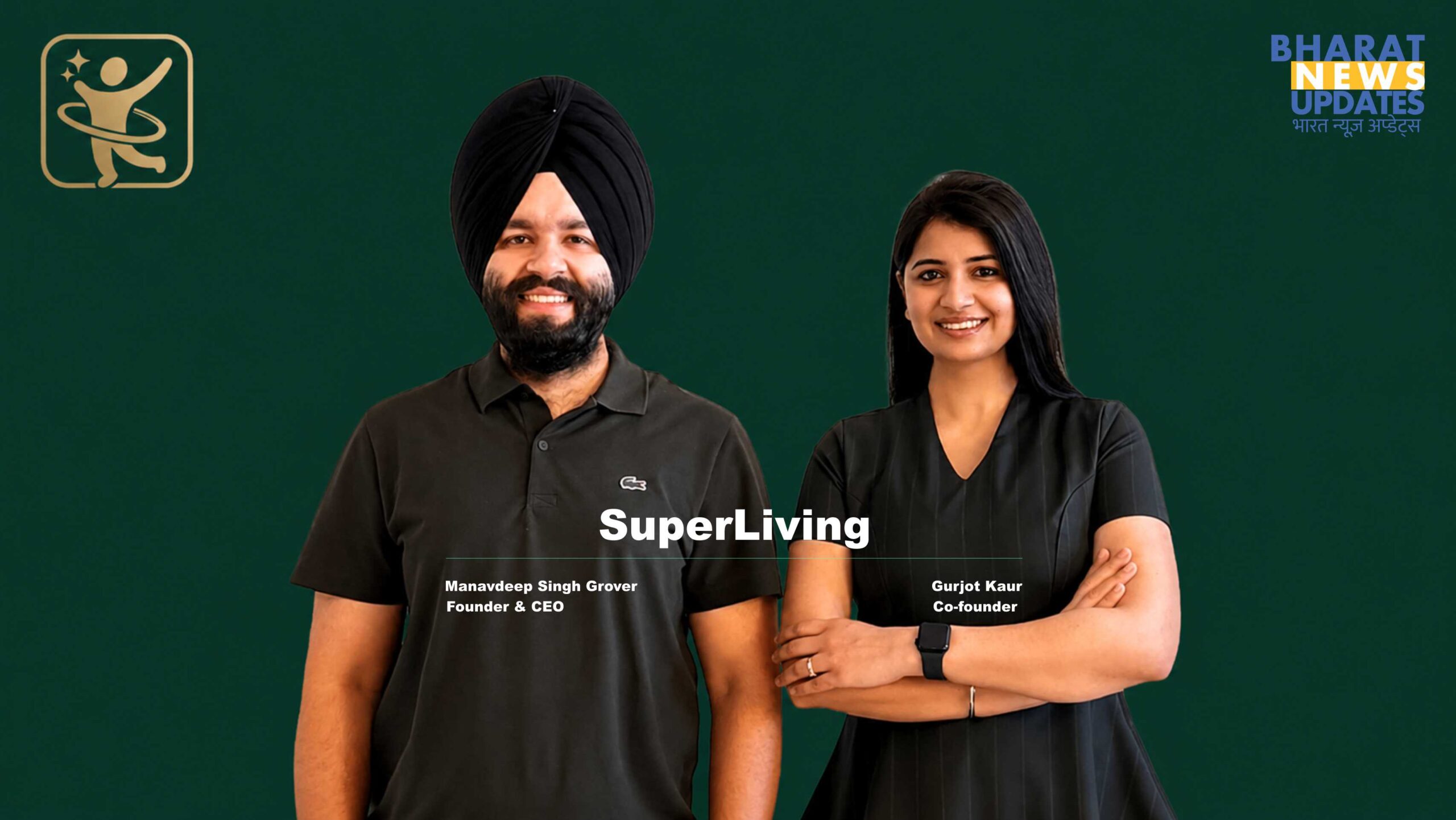
Most wellness startups in India launch with a pitch deck that includes a photo of a millennial in a Lululemon top, a green smoothie, and a gym membership. Their target customer quietly earns ₹3 lakh a month, lives in Bengaluru or Gurgaon, and already has access to a nutritionist.
SuperLiving looked at that market and walked the other way.
The Bengaluru-based preventive health and wellness platform has just raised $7 million in a Series A round led by Lightspeed, with existing backers Kae Capital and All In Capital doubling down on their bet. The round values a company that, by most conventional startup timelines, shouldn’t even exist yet, it was founded barely a year ago, in 2025.
And yet, here it is: over 1.5 million app installs and more than 1 lakh paying users, 73% of them not from Mumbai, not from Delhi, not from Bengaluru, but from Meerut, Gangtok, Agra, Nashik, Bhiwadi, Varanasi, Hisar, Jalandhar, Indore, Jaipur and Visakhapatnam.
The Problem Nobody Was Solving Honestly
There is a health crisis quietly festering across India’s smaller cities. It isn’t tuberculosis or malaria. It’s fatigue that won’t lift, joints that ache without reason, sleep that never feels complete, and a gut that seems to have a personality disorder. It’s the kind of slow, grinding deterioration that doesn’t qualify you for the doctor’s waiting room but disqualifies you from living well.
The response from the healthcare industry? Mostly silence.
Urban hospitals are overwhelmed. Specialist consultations are expensive. And the wellness industry with its ₹4,000 diet plans and English-language YouTube coaches is built, almost by design, for people who already have their basics sorted. For the homemaker in Bhiwadi managing five people’s lives like a COO, or the young husband in Bathinda trying to show up for his family while running on empty, the system offers nothing except WhatsApp forwards and trending diets that vanish in two weeks.
This is the gap SuperLiving walked into not accidentally, but with a thesis.
The Founders: Not From Healthcare, Which Is Precisely the Point
Manavdeep Singh Grover, co-founder and CEO, is an engineer and IIM Lucknow MBA who spent years scaling new categories at Meesho Grocery, Sports, Furniture, a loyalty programme, the first-ever smart-coin rewards system before moving to Pocket FM as Director of Growth and Marketing, where he cracked the fantasy genre playbook and scaled it to become the platform’s biggest category in under eight months.
His co-founder Gurjot Kaur, equally an engineer and IIM Lucknow MBA, brought the content and cultural architecture. She shaped fashion discovery at Meesho and built high-engagement content experiences at Pocket FM. Together, they have a very specific superpower: they know how to build things that people in non-metro India actually keep using.
That last part actually keep using matters more in wellness than in almost any other category. Most health apps see 80% drop-off within the first month. Behaviour change is brutal. Grover and Kaur’s understanding of content loops, habit design and user psychology from their Meesho and Pocket FM days wasn’t incidental to SuperLiving, it was the foundation.
Before all of this, Grover had also founded Lakshya, which won the United Nations’ HULT Prize in the APAC region often referred to as the Nobel Prize for student entrepreneurs. He was featured in Forbes D2C as one of India’s Top 50 Most Competitive Leaders. He also ranked in the Global Top 10 for COVID relief policy-making for the European Government. This is not a founder who stumbled into entrepreneurship. This is someone who’s been building for a decade and chose health as the next frontier for personal reasons. Kae Capital, in their investment note, specifically mentioned that Grover has “lived experience with health struggles” the kind of founder motivation that doesn’t sound like a pitch but feels like a calling.
The Uncommon Architecture Behind the App
Here’s what most coverage of SuperLiving gets wrong: it describes the platform as a wellness app. That’s a bit like calling Spotify a music storage solution.
What SuperLiving is building is closer to a contextual health companion, an AI system that tracks over 115 lifestyle parameters across nutrition, movement, sleep, stress, and daily habits, and doesn’t reset its memory every time you open the app. That might sound like a small thing. It isn’t.
Every other health app starts fresh with you every session. You tell it you’re trying to lose weight, it gives you a calorie target. Next week you come back; it gives you a calorie target again. It has no idea that you missed sleep for three nights because your child was sick, or that you’ve been stress-eating because of a job change, or that you gave up on the plan twice before.
SuperLiving’s AI companion tracks the full arc. It adjusts. It remembers. It makes recommendations that account for the messy context of your actual life rather than the sanitized version most apps assume.
The content is also built in regional languages not translated but architected for vernacular understanding, which is a significant distinction. A translated English article about macronutrients and a piece written from scratch in Bhojpuri for someone who grew up eating dal-roti at every meal are not the same thing. One informs; the other connects.
And the price. Wellness advice on SuperLiving is priced in the ₹99–₹250 range. That’s less than a single Swiggy order. Less than a parking charge in Connaught Place. For users in Tier 2 and Tier 3 India price-sensitive, often making health decisions for the whole family, this isn’t a marketing tactic. It’s what makes adoption possible in the first place.
The Hidden Reality of 73%
The statistic that 73% of SuperLiving’s paying users are from Tier 2 and Tier 3 cities deserves more than a bullet point.
In the startup world, “Bharat” is frequently invoked as a target market. Investors love the slide. Founders love the language. The reality is that most platforms that claim to serve Bharat still see their highest engagement from the top six metro cities they just don’t say so publicly. The retention data, the paying user data, the lifetime value data, it tells a different story.
SuperLiving’s numbers say the opposite. Gangtok (a city with no metro, no startup ecosystem, and patchy internet) is one of their top-performing markets. That’s not a coincidence; it’s validation of a design philosophy.
When specialist health advice is genuinely unavailable in a geography, no good nutritionist in Hisar, no sports medicine doctor in Bhiwadi, an AI companion that costs ₹150/month fills a real gap, not an aspirational one. The demand was always there. The supply wasn’t.
The Funding Trajectory: Remarkably Fast
Before this Series A, SuperLiving had raised ₹2 crore from All In Capital in September 2025, after winning the “Elevator Pitch” competition. That was the seed. Just months later, in January 2026, Kae Capital led a $2 million round with participation from All In Capital and angels.
Five months after that, Lightspeed is leading a $7 million Series A.
For context: that’s three funding rounds in approximately nine months. In an environment where many startups wait two to three years between rounds, this kind of velocity signals one thing, the metrics are working. Investors don’t move this fast on storytelling alone.
Harsha Kumar, Partner at Lightspeed India, didn’t mince words: “Most wellness platforms are built for the top of the pyramid. SuperLiving is building for the rest of India affordable, vernacular, culturally grounded, and actually sticky. The early traction from Tier 2 and Tier 3 users tells you everything about where the real demand is.”
The word “sticky” is the tell. In consumer tech, stickiness is the metric that separates a product from a download. SuperLiving is apparently building both.
Where the ₹65.9 Crore Goes
The $7 million (approximately ₹65.9 crore) will be deployed across four areas:
AI deepening: SuperLiving’s personalization engine already tracks 115 parameters. The next phase is making those 115 parameters smarter, faster and more predictive. The AI companion should eventually flag a likely sleep disruption before it happens, not just respond to it after.
Vernacular content expansion: Creating content that works in 8–10 Indian languages, not just in the linguistic sense but in the cultural one. Different communities have different relationships with food, with rest, with what counts as stress. The content needs to reflect that.
Product innovation: SuperLiving plans to move beyond wellness coaching into diagnostics and health commerce, essentially becoming a preventive health infrastructure layer, not just a content destination. Think: personalized lab test recommendations, supplements, diagnostic packages anchored in the user’s specific data.
User acquisition in Tier 2 and Tier 3: Scaling in cities where customer acquisition looks completely different from metros. Word-of-mouth is stronger. Community trust matters more. WhatsApp groups are the distribution channel.
The Contradiction at the Heart of Preventive Health
Here’s the honest tension inside every preventive health startup: the people who need it most are the hardest to monetize.
Urban, affluent users have the money, the data literacy, and the prior wellness infrastructure to complement an app. They’re also the users who churn fastest because they already have options. Tier 2 users have genuine need and genuine intent but they’re price-sensitive, their trust threshold is higher, and converting them requires significantly more hand-holding.
SuperLiving’s ₹99–₹250 pricing makes it accessible but compresses margins. Scaling a low-price, high-engagement model to profitability in a country this size requires either massive volume or a move into higher-margin adjacent categories which is exactly what the diagnostics and health commerce pivot suggests.
This is the right long game. But it’s a long game. And the path from 1 lakh paying users to the kind of scale that makes the unit economics irresistible will require more than an AI companion that remembers your sleep data.
What Nobody Else Is Saying About SuperLiving’s Real Moat
The conversation around SuperLiving focuses heavily on AI, which is understandable but slightly misses the point.
The real moat being built here is behavioural data at scale from non-metro India, the most under-represented demographic in global health datasets. As the platform accumulates information on sleep, nutrition, stress, and lifestyle patterns from users in Indore, Agra and Vizag, it is building something that no hospital chain, no insurance company, and no Western wellness platform has: a ground-level picture of how India’s forgotten middle actually lives, sleeps, eats and breaks down.
That data compound is worth far more than any single feature. It’s the foundation for insurance partnerships, employer wellness programmes, government health schemes, and pharmaceutical companies trying to understand lifestyle disease patterns in real time. SuperLiving may call itself a wellness app today. In three years, it might be the most comprehensive behavioural health database in South Asia.
The Simple Truth
India doesn’t have a healthcare problem. It has a prevention problem.
We spend money on hospitals when people collapse. We spend almost nothing on helping them not collapse in the first place. The family doctor who knew your whole lifestyle, your stress triggers, your sleep patterns, your dietary quirks that person barely exists anymore, and certainly doesn’t exist for the majority of Indians living outside the top 10 cities.
SuperLiving is attempting to rebuild that relationship not with a human, but with an AI that has read your entire health story and doesn’t forget it. Whether that works at the scale they’re targeting is still a question. But the bet is an honest one, placed on a real problem, by founders who understand what it costs to build things people actually keep.
That’s rarer than it sounds.
SuperLiving is available on Android and iOS. Subscription plans start at ₹99.
Bharatnewsupdates Business Insight Team ⊥ June 2026, 25