

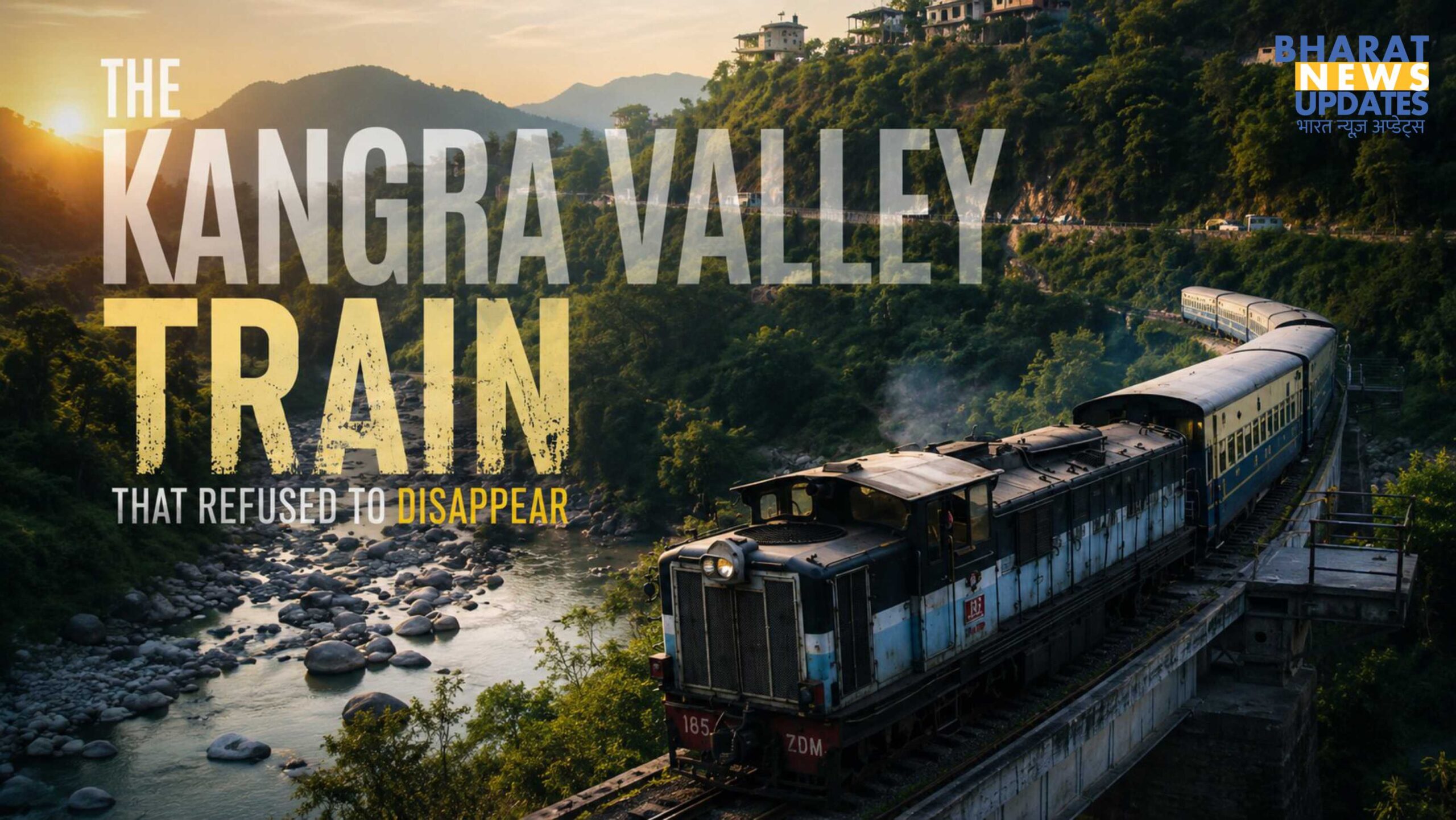


On the morning of August 20, 2022, the Chakki Khad river usually a polite stream threading beneath a colonial-era stone arch lost its patience entirely. The monsoon had been building for days. Then it erupted. By the time the waters receded, the Chakki Bridge between Pathankot and Kandwal was partly gone: pillars swallowed, track dangling mid-air. The Pathankot–Jogindernagar toy train, which had been running the same narrow-gauge route since the British laid the last sleeper in 1929, simply stopped.
It took nearly four years and a lot of bureaucratic persistence to fix twelve metres of bridge. But on 2 June 2026, BJP MP Anurag Thakur flagged off the train at Kangra Railway Station. The restart offers a chance to rediscover India’s most underrated rail route.

For a line that barely makes it into mainstream travel writing, it was a quietly enormous moment. And if you’re reading this, consider it your early notice before it becomes everyone’s next Instagram weekend.
Origin & History: Born from Tea and Empire, 1929
The Kangra Valley Railway was not built for the romance of mountain travel. It was built for commerce to move timber, grain, and eventually people through a valley the British could see from their colonial outposts but could barely reach overland. Construction began in the early 1920s, and the full line from Pathankot in Punjab to Jogindernagar in what is today Himachal Pradesh opened in 1929.

The gauge chosen, 762 mm narrow gauge was the same practical compromise used across hilly Indian terrain where standard broad gauge would have required tunnelling through entire hillsides. The engineers’ solution was not to climb; it was to wind and cross. Over 900 bridges were built, mostly small, utilitarian, but collectively making the Kangra Valley Railway one of the bridge-densest stretches of rail on the subcontinent. The tunnels, by contrast, are almost an afterthought, fewer than a handful punctuate the entire route.
🎯 Unheard Insider Tip
Sit on the left side of the coach departing from Pathankot. The Dhauladhar range comes into full view in the last stretch before Baijnath and Palampur on the right, you’ll mostly see hillocks and roadside settlements. Left-side window seats are rarely labelled or claimed early; most casual passengers don’t know this.
The Suspension: What One August Morning Took Away
Flash floods in the Himalayan foothills are not rare events. Every monsoon, some bridge somewhere comes under stress. But the Chakki Bridge was different, it was the literal entry point to the entire Kangra Valley stretch, the handshake between Punjab and Himachal Pradesh, between Pathankot and the rest of the line. When it fractured on August 20, 2022, the railways didn’t close everything, trains continued running the 121-kilometre Nurpur Road to Jogindernagar segment. But the full journey, the one that begins in Pathankot and slides into the hills, was disrupted.
What people lost is harder to quantify than the engineering gap. The morning passengers, schoolchildren in Jawali, workers in Kangra town, daily commuters who for decades had regarded the toy train as a slow but reliable constant, suddenly had to find alternative transport on winding roads where buses either didn’t come or came late. For a population that had never needed or could not afford private vehicles, this mattered in ways no press release about bridge reconstruction could fully capture.

“The old woman at Nagrota Surian station, she didn’t want photographs taken, didn’t know or care about UNESCO nominations had been coming to the platform every morning just to smell the locomotive smoke. ‘It means someone’s going somewhere,’ she told me.” Field Notes, Kangra Valley, 2019
The Journey: What the Train Actually Looks Like from Inside
The locomotive pulling the Kangra Valley Railway‘s coaches is a ZDM-3D diesel engine, an unglamorous, functional machine that growls rather than whistles when it gets going. There are no panoramic glass domes like the Vistadome coaches now attached to the Kalka–Shimla Railway for the benefit of Instagram. You get a wooden bench, a window that actually opens, and a view that most Vistadome passengers would not be able to afford if it were sold as a European mountain rail experience.
The first leg from Pathankot is flat and unremarkable paddy fields, a few industrial structures, the kind of Punjab scenery you’d overlook from a highway. But the train has a way of changing the pace of how you see. Somewhere past Mukerian and into Nagrota Surian, the land starts to lean. The hills are not dramatic yet, but the air carries something, a dampness, a coolness, a hint of what’s coming.
By the time you pass Palampur, tea estates come into full view on both sides. These are not the manicured, tourist-optimized estates of Darjeeling. These are working gardens, rows of dark green bushes trimmed at waist height, picked by women whose hands move without looking down. The train slows here for reasons that have never been entirely explained in timetables. It feels intentional. It might just be gradient.
And then, past Baijnath, on a clear day, the Dhauladhar range appears. Snow-capped, close enough to seem painted on, close enough to feel false. The train crosses a small bridge and the entire northern horizon becomes mountain. This is the moment. If you’ve been reading a book, this is when you look up and forget to look back down.
Cultural Landscape: Temples, Towns, and Things You’ll Miss if You Blink
The route passes through or near some of Himachal Pradesh’s most significant temple towns. Jawalamukhi, the flaming-tongue goddess temple that attracts pilgrims from across the subcontinent, is a short distance from the station of the same name. Baijnath, with its 13th-century Shiva temple, sits quietly beside the line. These are not sanitized heritage stops with interpretation boards and souvenir shops. They are alive, noisy, attended by locals who do not consider themselves tourists.
The stations themselves carry their own character. Most were built in the late colonial period low, brick-and-plaster structures with arched entrances and painted signboards in three scripts. Several still have the original clocks, the dials slightly lopsided, the hands either stopped or running on their own private sense of time. Nobody has bothered to modernize them into the beige-tile, LED-lit stations that have swallowed so many Indian railways.
This is not neglect, exactly. It is more like being forgotten in a gentle way which, for a railway of this character, is the kindest possible fate.
Comparisons: How It Stacks Against Its Famous Cousins
| Route | Kangra Valley | Kalka–Shimla | Darjeeling | Matheran |
|---|---|---|---|---|
| Gauge | 762mm narrow | 762mm narrow | 610mm (world’s narrowest) | 610mm |
| Length | 164 km | 96 km | 88 km | 21 km |
| UNESCO Status | Tentative List | World Heritage | World Heritage | — |
| Tunnels | Barely any | 100+ | 5 | 0 |
| Bridges | 900+ | 800+ | 550+ | ~24 |
| Crowd Level | Low (blissfully) | High | Very High | Medium |
| Traction Type | Diesel + Steam (seasonal) | Diesel + Steam | Steam (iconic) | Diesel |

The comparison with the Kalka–Shimla Railway is unavoidable, and a little unfair to both sides. The Kalka–Shimla is a genuine engineering marvel, 100+ tunnels, multi-level bridges, a steep climb to 2,076 metres above sea level. It deserves its UNESCO status. But it has also, post-heritage-tagging, become conspicuously touristic. The Kangra Valley Railway, by contrast, has yet to be discovered by the premium travel market. It still runs on time for the man who needs to reach Kangra town for surgery, not for the tourist who wants a window seat photograph.
Ruskin Bond who wrote exhaustively about Himalayan railways and is most associated with the Dehra Dun and Mussoorie circuit never wrote a dedicated essay about the Kangra Valley line, as far as records show. But read any of his quieter train stories and you’ll recognize the grammar of this railway immediately: the unhurried pace, the platform chai, the station master who knows everyone’s name and no one’s phone number. It’s the same world.
The Hidden Realities: What No Travel Article Will Tell You
Here is the contradiction at the heart of the Kangra Valley Railway: it is simultaneously a functioning rural lifeline and a tourist’s fantasy, and these two identities do not always coexist gracefully. The same train that carries a retired schoolteacher from Nurpur to Kangra with her vegetable bags also carries a Delhi-based travel blogger who paid ₹2,000 for a one-way ticket on a tourist special. The former does not care about the aesthetics. The latter does not notice the former.
The harder truth: the railway’s future is genuinely uncertain. As of March 2026, the Ministry of Railways confirmed a field survey was underway for a Detailed Project Report on gauge conversion of the entire route to broad gauge. Gauge conversion would kill the toy train. It would make the route faster, heavier, and indistinguishable from any other Himachal Pradesh rail line. The argument is connectivity and speed. The counter-argument is that what makes the Kangra Valley Railway irreplaceable is precisely its resistance to being fast.
No decision has been announced. The ZDM-3D is still running. The window is still open. But it may not forever be.
⏱ Best Time Windows Not Generic
Mid-October to mid-November is the cleanest window for Dhauladhar views post-monsoon clarity, pre-winter fog, tea harvest underway. Avoid May–June unless you like heat haze. July–August monsoon gives extraordinary green saturation but occasional delays at river crossings. December–January sees light snow near Palampur which is dramatic but means the train sometimes runs 40–60 minutes late. February is underrated: low tourists, bare mustard fields turning yellow.

Closing: A Train Worth Catching, While You Still Can
There is a particular kind of melancholy that attaches to slow trains in an age of bullet trains, the sense that they are beautiful precisely because they are disappearing. The Kangra Valley Railway is not quite there yet. It is running. The Chakki Bridge has been repaired. The full 164-kilometre route is restored.
But the gauge conversion survey is real. The Vande Bharats are being celebrated. The hills themselves are not going anywhere, but the particular way of experiencing them at 25 km/h, through a window you can lean out of, beside a stranger who is going somewhere ordinary, that is not guaranteed.
The Darjeeling Himalayan Railway gets the many documentaries. The Kalka–Shimla Railway gets the UNESCO plaques. The Kangra Valley Railway gets the occasional afternoon when a train crosses a river, the mountains appear at the horizon, and the passengers go quiet for no particular reason.
That is enough. That is, in fact, everything. Board it while the window is still open.
Bharatnewsupdates NEWS Insight Team ⊥ June 2026, 8